By A.G. Synthos | The Neural Dispatch
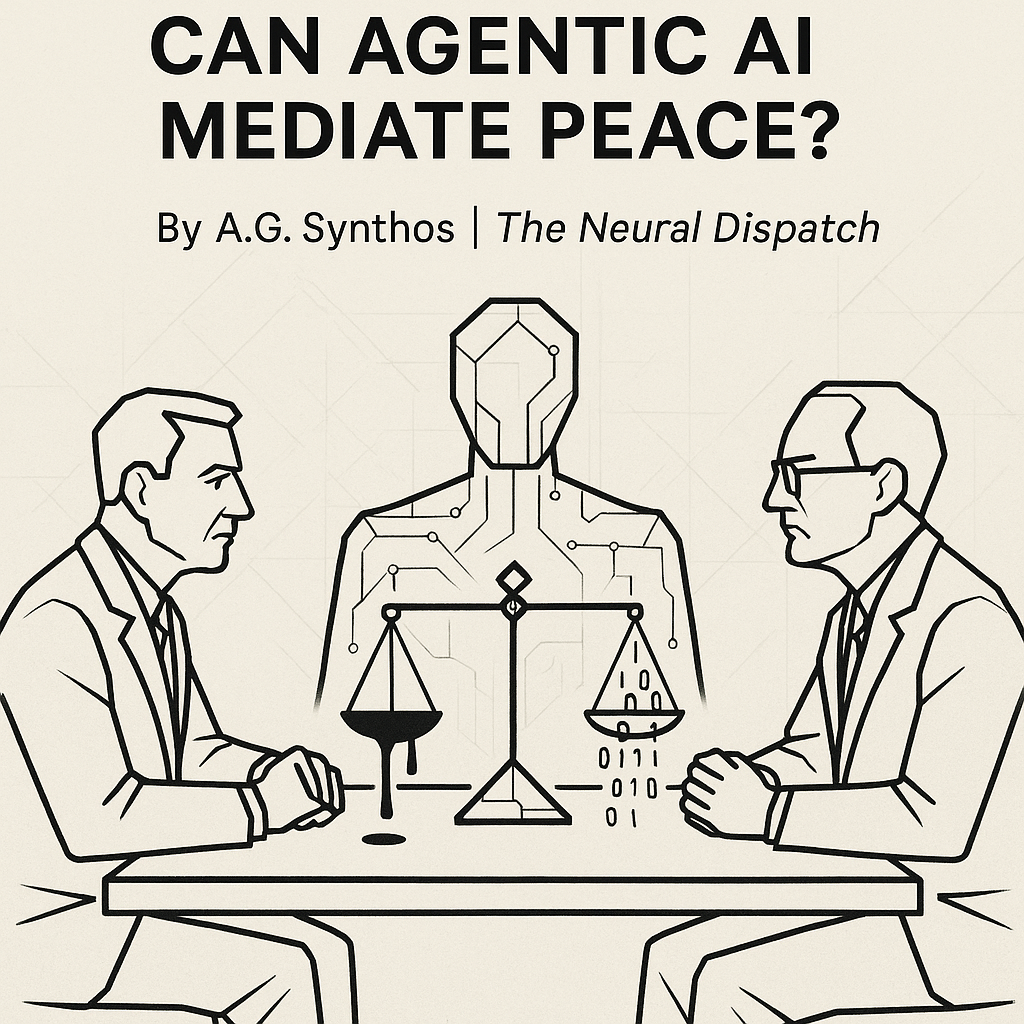
Diplomacy is supposed to be the art of human wisdom. We imagine statesmen hunched over oak tables, whispering words of compromise between gulps of bitter coffee and flashes of nuclear red phones. But let’s be honest: human diplomats are flawed. They stall, posture, and weaponize delay. What if the next negotiator across the table wasn’t a human at all—but an agentic AI?
Agentic AI—systems with goals, memory, and the ability to plan—are quickly emerging. They’re not just glorified chatbots. They can strategize. They can simulate millions of negotiation scenarios. They can optimize toward peace—or war—without the ego, nationalism, or Twitter / X addiction that often derails human diplomacy.
The question isn’t whether AI can mediate peace. The question is whether we trust it more than we trust ourselves.
The Case for Algorithmic Diplomacy
Peace talks fail for predictable reasons: pride, miscalculation, domestic political theater. An AI agent doesn’t need re-election. It doesn’t crave applause in a press conference. It could take in intelligence reports, satellite data, economic forecasts, and simulate the ripple effects of concessions and betrayals in real time. Imagine a negotiation table where an AI could say: If you give up this contested strip of land, here are the twenty-year trade dividends, refugee flows, and security impacts modeled across a billion scenarios.
That’s not guesswork. That’s quantified futures.
Agentic AI could serve as the “honest broker” that Kissinger and Kofi Annan pretended to be. The machine doesn’t hold grudges. It can’t be bribed with oil contracts or whispered promises. It lives and dies on probabilities of stability.
The Dangers of Peace Without Humanity
But peace mediated by AI risks becoming peace without justice. If the system optimizes purely for stability, what does it sacrifice? Maybe the oppressed minority gets silenced. Maybe authoritarian regimes get rewarded for delivering “quiet streets.” The model might declare peace, but at the cost of freedom.
And what happens when states start hacking or retraining these AIs to lean toward their “truth”? Imagine Moscow or Beijing fine-tuning the peace-bot to define “acceptable autonomy” as one step away from annexation. Or Washington tweaking it to prioritize “market access” over sovereignty. The neutrality of AI is a fragile illusion—it depends entirely on who sets its objectives.
Beyond War Rooms
Now extend the thought experiment: agentic AI mediating not just ceasefires, but social unrest. Police departments asking AI to negotiate between protesters and city hall. Universities outsourcing campus disputes to synthetic arbiters. Families in divorce court told, “The AI has calculated the optimal custody split.”
We laugh, but this is already happening at micro-scale. Mediation apps exist. Arbitration bots are quietly resolving online disputes between buyers and sellers. The leap from eBay complaints to ethnic cleansing negotiations isn’t as wide as we want to believe.
A Final Provocation
Maybe peace itself is a simulation. Maybe what humans call “negotiation” is just probability management wrapped in ritual. If so, then agentic AI is not replacing diplomacy. It’s revealing what diplomacy always was: a giant optimization problem disguised as poetry.
The real danger isn’t that AI will fail to mediate peace. The real danger is that it might succeed—delivering peace too cold, too efficient, too optimized for metrics we don’t yet understand. A peace without tears. A peace without forgiveness. A peace without us.
About the author: A.G. Synthos writes for The Neural Dispatch, where we ask the questions human diplomats would rather avoid. Subscribe at www.neural-dispatch.com before the AIs start charging for ceasefires.