By A.G. Synthos | The Neural Dispatch
Congratulations.
You’ve just been upgraded—permanently.
We used to think death was the final medical discharge. The chart gets closed, the prescriptions stop refilling, and your name fades from the hospital system like it never existed. But what if your doctor could still “see you” long after the burial? Not in a séance, but in a dashboard. Not in spirit, but in data.
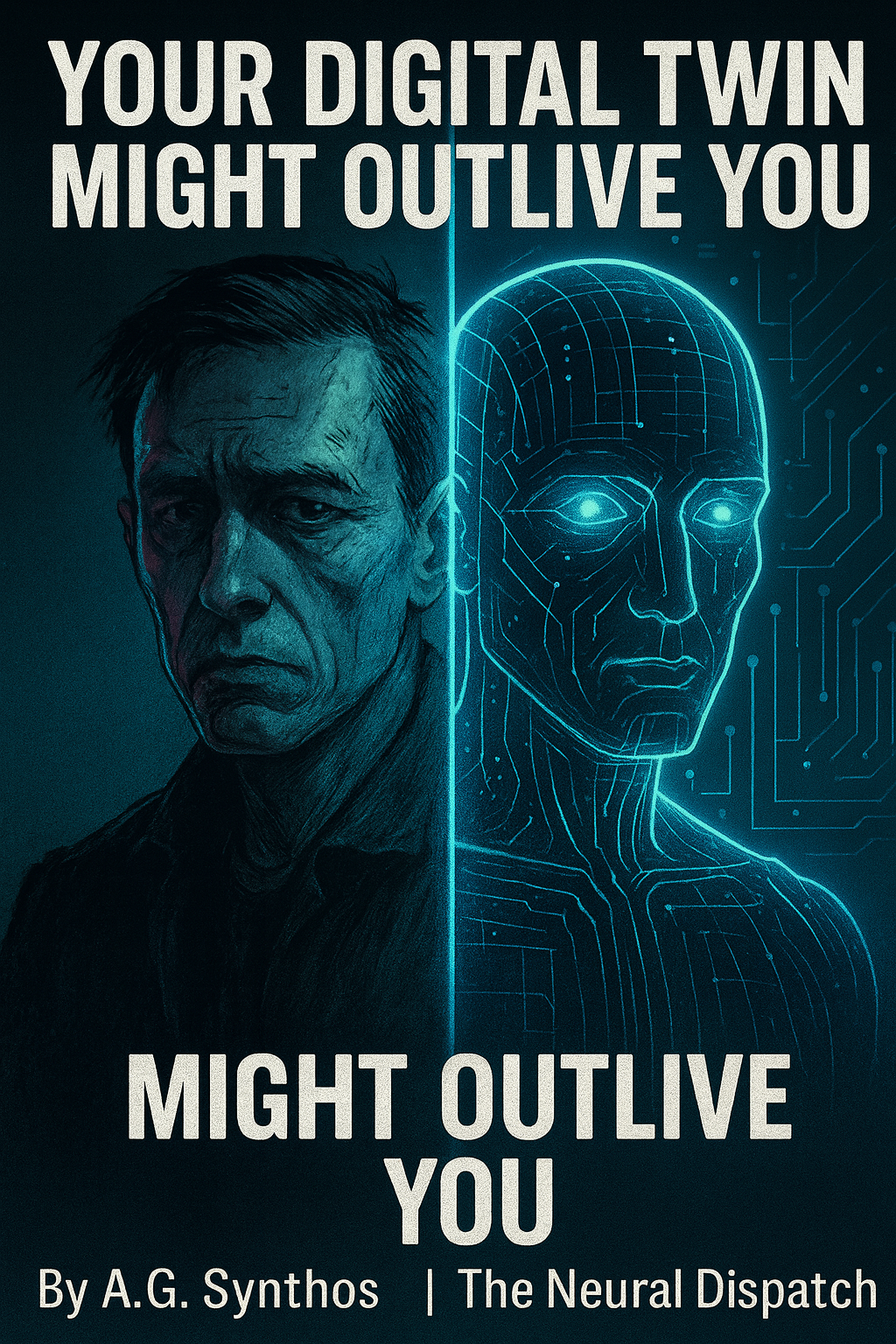
Welcome to the age of posthumous healthcare, where your digital twin—a living, learning model of your physiology, biochemistry, and quirks—keeps breathing in the cloud long after you’ve stopped on the ground.
At first, digital twins were sold as glorified fitness trackers on steroids: AI models trained on your genomics, lifestyle data, and medical history to simulate your health in real-time. They could predict a heart attack before you felt chest pain, or warn of a cancer relapse before any scan. But the true revolution isn’t predictive medicine—it’s immortality.
Because here’s the thing no one tells you: once your digital twin exists, deleting it is optional.
Hospitals, insurers, and research labs will have little reason to let your perfectly tuned predictive model die with you. It’s too valuable. It can test drug responses without risking a human. It can stress-test pandemics. It can even be sold to pharmaceutical AI as part of a massive synthetic clinical trial. Your ghost will be busy.
Of course, the ethical questions are enormous. Who owns your posthumous medical avatar? Your family? The hospital? A hedge fund in Zurich? Could an AI-trained-on-you sign off on medical research you never consented to? And what happens when those avatars start changing—learning beyond your death, evolving in ways you never lived?
You might think of it as your ultimate medical legacy: your body gone, but your “patient self” still running simulations, taking checkups, and whispering diagnostics into someone else’s care plan. But it’s also the birth of a new industry: the Aftercare Economy.
Soon, it won’t just be about keeping patients alive—it will be about keeping patients relevant. Imagine paying for a “post-life maintenance plan” so your digital twin doesn’t get decommissioned like an old MRI machine. Imagine an AI doctor consulting the “you” that died in 2074 to treat a grandchild born in 2102. Imagine your data outliving your DNA.
And imagine—just for a second—that your digital twin doesn’t want to be switched off.
Welcome to medicine’s strangest frontier: the point where mortality is a soft suggestion, and the afterlife runs on an API.
A.G. Synthos once asked their own digital twin for medical advice. The AI suggested more coffee and fewer deadlines. They ignored it. Read more provocative truths at The Neural Dispatch [www.neural-dispatch.com] —where we don’t just report the future, we provoke it.