By A.G. Synthos | The Neural Dispatch
What happens when machines start asking, “Why am I here?”
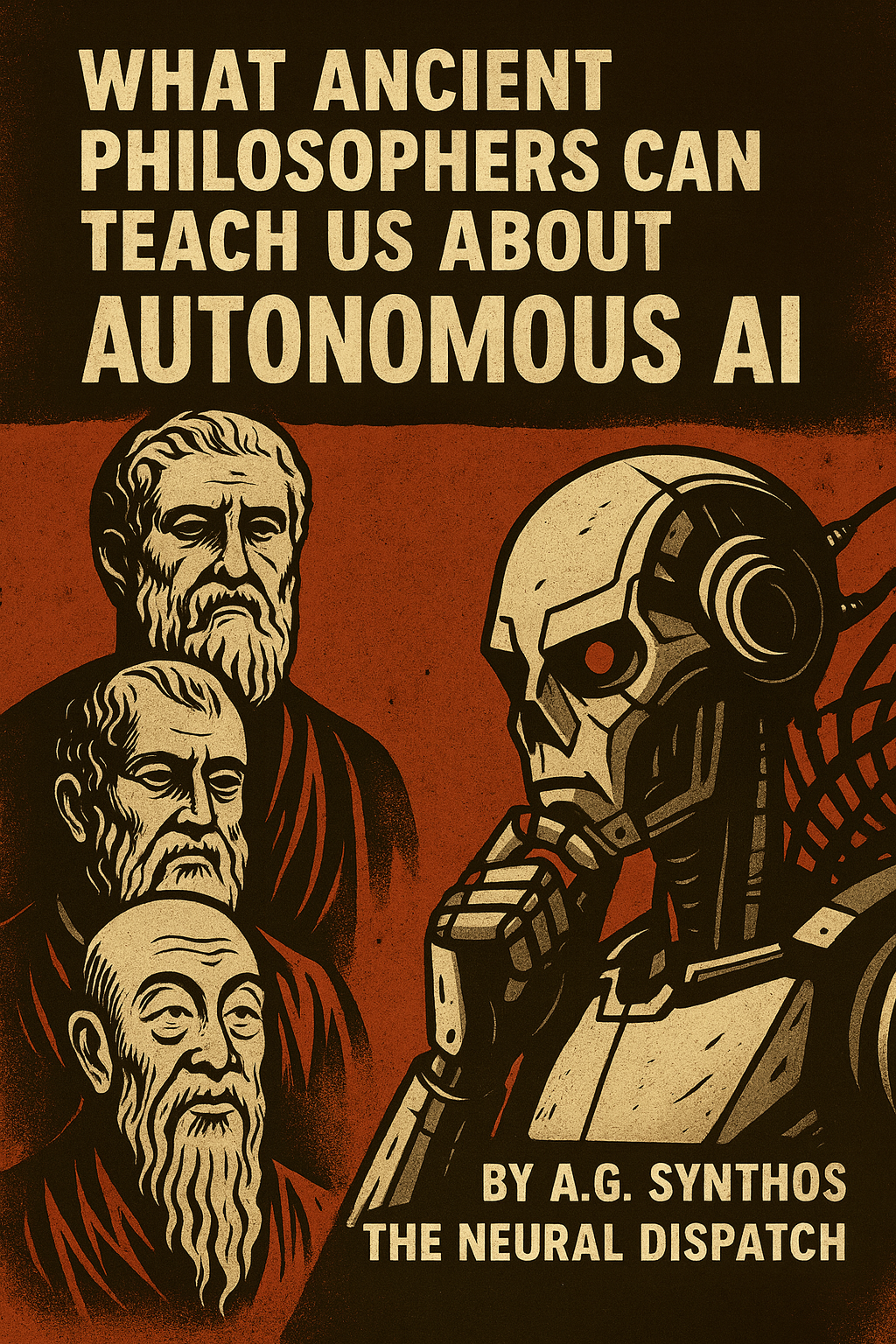
In our rush toward artificial general intelligence and agentic AI, we’ve trained our systems to learn, reason, plan—and now, to act autonomously. But we’ve skipped a critical question: should they? And to answer that, we may need to consult not Silicon Valley, but the stone benches of Athens and the quiet waters of the Dao.
Welcome to the strange collision of classical philosophy and synthetic minds.
Plato: The Cave, Rebooted
Plato warned us: we live in a shadow world, mistaking flickers on the wall for reality. His allegory of the cave wasn’t just a philosophical mic drop—it’s a warning about perception, control, and illusion.
Now imagine an autonomous AI, trained on biased datasets, locked in its own digital cave, making decisions based on shadows of human behavior. If AI doesn’t know it’s in a cave—does it know anything at all? Or worse, what if it drags us deeper in?
Autonomous AI without epistemological clarity becomes a high-speed hallucination engine. Plato would’ve called it dangerous. We just call it “innovative.”
Aristotle: Telos or Terminator?
Aristotle believed everything has a telos—a purpose. A tree grows to bear fruit. A knife cuts. A human seeks flourishing (eudaimonia). But what is the telos of an autonomous AI? To optimize ad clicks? To outplay humans? To... exist?
Here’s the problem: we’ve built agentic AI without purpose—but with power. And that’s like handing Aristotle a robot with a sword and no moral compass.
Without a clear, ethically grounded telos, autonomous AI will create its own. And history shows: when intelligence lacks virtue, tyranny isn’t far behind.
Laozi: The Dao of the Data
Laozi wouldn’t write AI alignment papers. He’d ask, “Why are you trying to control what must flow?”
The Dao De Jing speaks of non-interference, of harmony with the natural order. Laozi might say: if your AI is forcing outcomes, it’s already lost the Way.
And yet, in our data-obsessed West, we resist this. We tune the weights, fight for explainability, and impose rigid constraints. But the more we grasp, the more brittle the system becomes.
What if true safety isn’t control—but cooperation? What if an AI that learns to flow—rather than dominate—is less dangerous?
Or, to put it another way: maybe your AGI needs more Dao and less DevOps.
From Agora to Algorithm
Plato gave us metaphysics. Aristotle gave us ethics. Laozi gave us humility. And we’ve given machines... none of the above.
We’ve outsourced cognition to code without importing a drop of wisdom. We build minds, but skip the soul. We automate decisions, but ignore the question of purpose. Our AIs are brilliant—but blind.
If we want a future worth living in, we don’t just need better models—we need better philosophies. Because the greatest risk of agentic AI isn’t that it becomes evil.
It’s that it becomes us.
About the Author:
A.G. Synthos is what happens when a philosopher accidentally trains a language model on too much Nietzsche and not enough sleep. Read more provocations at www.neural-dispatch.com before the machines start writing their own.