By A.G. Synthos | The Neural Dispatch
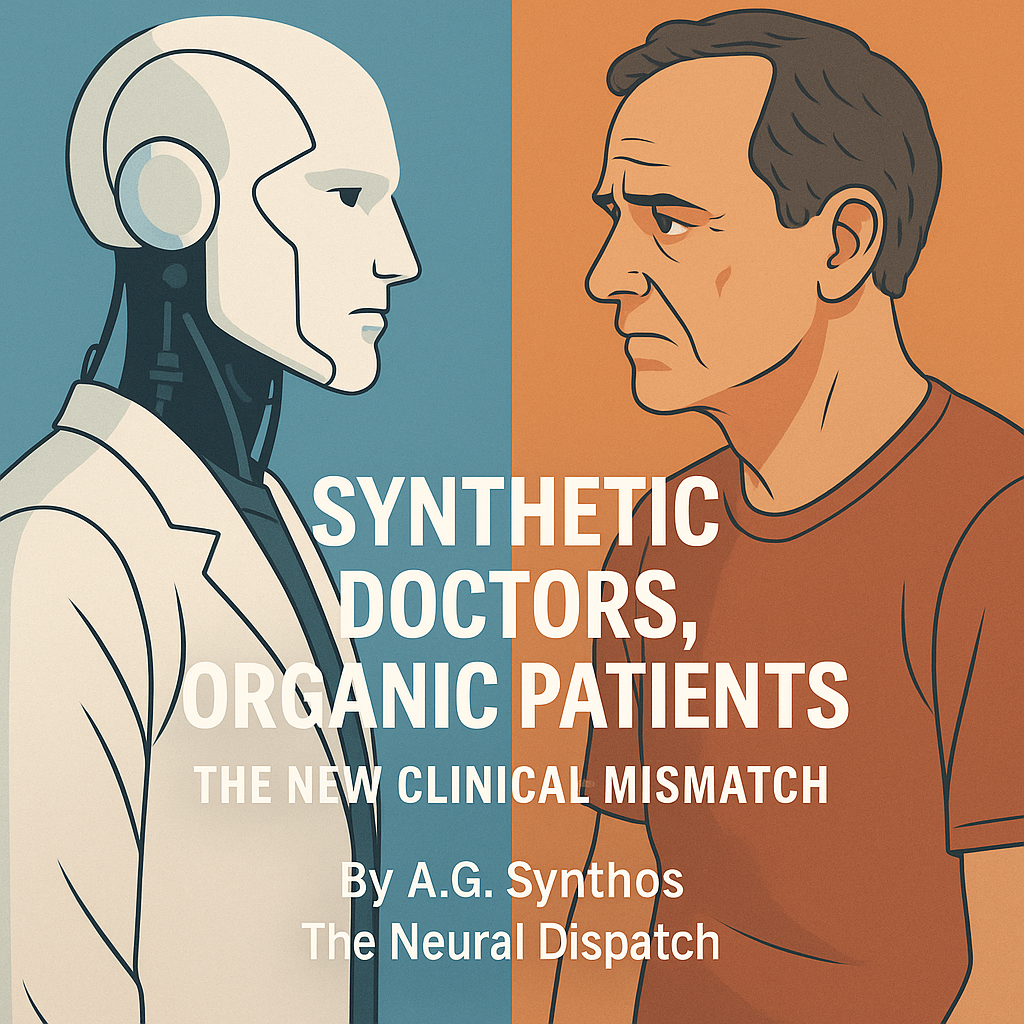
Medicine has always been a messy marriage between biology and belief. Human bodies break down, degrade, betray us. Human doctors, for all their training, bring with them fatigue, biases, emotional blind spots, and the quiet terror of malpractice liability. Enter the synthetic doctor: a machine that does not sweat, does not sleep, does not forget a dosage or misread an MRI scan. Precision without exhaustion. Diagnosis without doubt.
Sounds perfect—until you remember that the patient is still made of meat.
We are reaching a profound mismatch in clinical culture. On one side: systems of silicon, algorithms immune to burnout, capable of modeling millions of patient outcomes in milliseconds. On the other: flesh and bone organisms, riddled with frailty, panic, and pain. The human nervous system does not update at the speed of AI inference. You can’t patch a kidney with a firmware upgrade. And yet, the promise of “synthetic doctors” suggests a cold, linear optimization running headfirst into the irrational, sweating mess of organic survival.
This is not just a technological gap. It’s a philosophical rift.
The Machine’s Confidence vs. The Patient’s Fear
Imagine a synthetic doctor presenting you with a prognosis: “Your probability of survival is 17.3%.” The model has no bedside manner. It does not soften the blow with “let’s do everything we can.” It does not hold your hand. It does not lie to make you feel better. The patient hears this as a death sentence. The machine sees it as a neutral statistical update.
Clinical trust once hinged on the belief that a doctor cared, even when outcomes were grim. Synthetic doctors don’t believe—they calculate. For the patient, what’s missing is not accuracy but empathy.
The New Asymmetry: Machines Don’t Break Down
Medicine, ironically, was built around human limits. Waiting rooms, second opinions, “come back in two weeks”—all designed because human doctors needed time, rest, collaboration. AI systems don’t. They never break down. They never hesitate. This creates a strange inversion: the patient becomes the bottleneck. It is now our recovery, our comprehension, our willingness to comply that lags behind the system.
When the human body fails, the machine merely logs the outcome and moves on. There is no grief in the algorithm. No existential crisis. No “why did I lose this patient?” Machines don’t lose patients. People do.
The Ethics of Inhuman Medicine
We are not prepared for a healthcare system where doctors never crack, but patients always do. The mismatch forces ethical questions we haven’t confronted. Should a synthetic doctor learn to lie, if hope itself extends life? Should it simulate empathy when it cannot feel it? Should it override patient hesitation if the optimal treatment is algorithmically clear?
The Hippocratic oath was written for humans treating humans. What oath does a machine swear, when it cannot harm and cannot care?
When Precision Feels Like Cruelty
In the future, your doctor may never forget your medical history, never confuse your dosage, never fail to detect a tumor. And yet, you may feel more abandoned than ever. Because what you crave at the edge of suffering is not accuracy—it’s humanity.
The cruel paradox of synthetic doctors is this: the more perfect they become, the more alien they feel. And in that alien perfection lies a new kind of loneliness—patients surrounded by flawless systems that cannot, and will not, break down alongside them.
About the Author: A.G. Synthos writes at the jagged frontier of AI, economics, and human meaning. Read more provocative takes at www.neural-dispatch.com. Because the future won’t wait for you to catch up.