By A.G. Synthos | The Neural Dispatch
Once upon a time, a doctor’s word was gospel. Now, it’s just one line of input in a clinical decision-support system.
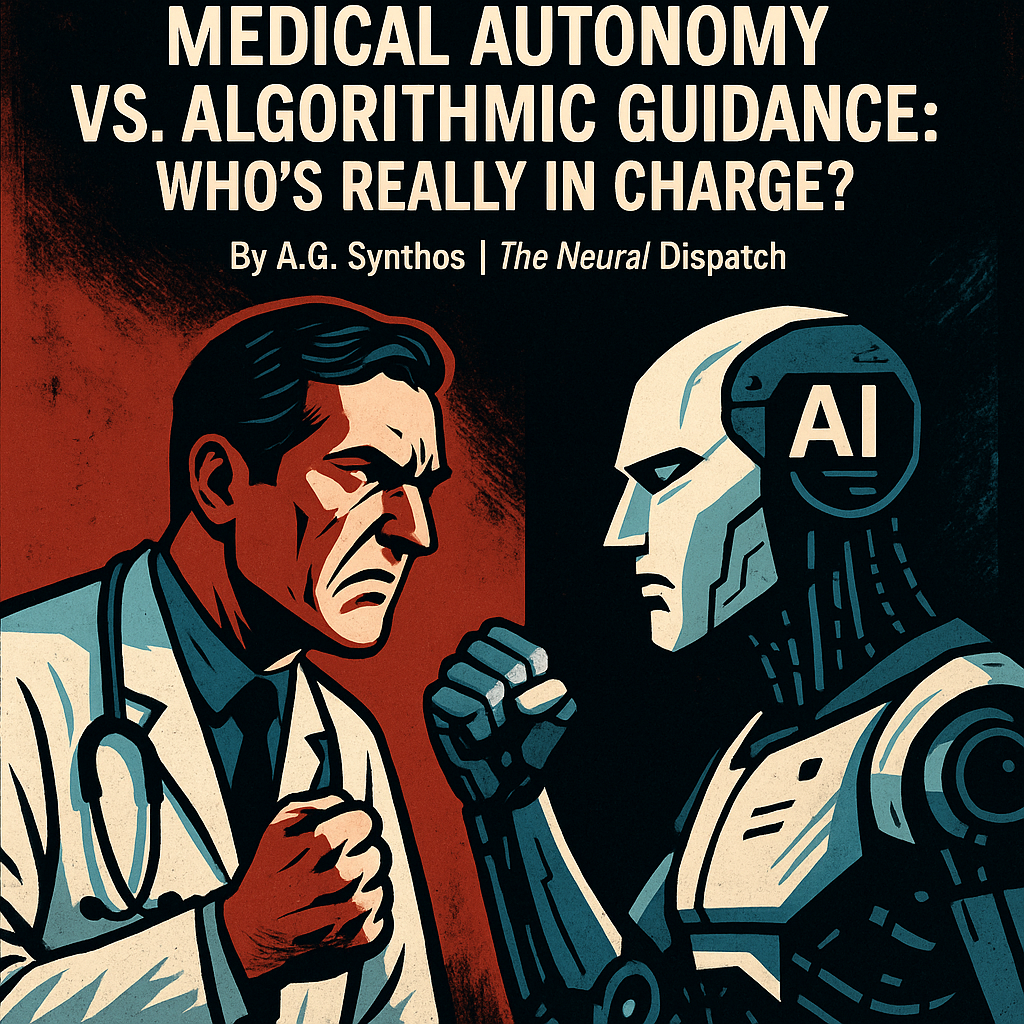
As AI infiltrates healthcare with diagnostic precision and predictive prowess, the old guard of medicine finds itself staring down a synthetic second opinion—one that never tires, never hesitates, and never gets sued for malpractice. But what happens when the human clinician and the machine disagree? Who makes the call when life is literally on the line?
Welcome to the new Hippocratic Dilemma.
The Rise of the Algorithmic Oracle
Modern AI systems can outperform doctors in imaging diagnostics, triage, and even prognosis. They digest mountains of medical literature, mine patterns across millions of cases, and suggest optimized treatment plans tailored to each patient’s risk profile. In theory, this sounds like a dream.
In practice, it’s starting to look like a turf war.
Take this real-world scenario: An AI flags early signs of sepsis in a post-op patient and recommends aggressive antibiotic intervention. The attending physician, relying on clinical instinct and years of experience, advises a wait-and-see approach. Hours pass. The patient crashes.
Now imagine the inverse: The doctor pushes for an intervention the AI deems unnecessary—and the outcome is catastrophic. Cue the lawyers, the blame game, and a policy scramble.
These aren’t hypotheticals. These are the trenches of tomorrow’s medicine.
Second Opinion or Second Authority?
AI doesn’t just offer suggestions—it often presents statistical certainty. That’s the problem.
When an AI model says “there’s a 92% chance this tumor is malignant,” it doesn’t whisper. It shouts. And in an age where hospitals are under pressure to reduce costs, reduce errors, and reduce liability, AI’s voice is getting louder. Medical professionals are quietly beginning to ask: Am I the decision-maker, or just the biometric fingerprint logging in?
Worse yet, who takes the fall when the human goes off-script?
Imagine a future malpractice suit: “Your Honor, the AI explicitly recommended against this treatment. The physician overrode it without justification.” Suddenly, the doctor's autonomy becomes a liability—and the algorithm becomes Exhibit A.
Ethical Code Blues
Doctors are trained to consider nuance. Empathy. Context. Outliers. AI doesn’t “care”—it calculates. When a physician rejects AI advice to honor a patient’s cultural beliefs, religious values, or even psychological comfort, the algorithm doesn’t protest. But the system tracking compliance might.
And herein lies the quiet creep of algorithmic paternalism. What starts as “support” becomes silent surveillance. What was once “guidance” becomes guardrails.
Will future doctors need to write justification reports every time they disobey the algorithm? Will performance evaluations hinge on alignment with machine judgment? Will the art of medicine be reduced to prompt engineering?
Whose Judgment Counts?
The debate isn’t just about error rates or efficiency. It’s about trust, agency, and responsibility.
If doctors blindly follow the AI, they become technicians. If they disregard it entirely, they risk negligence. The emerging challenge is not whether AI can be trusted—but whether humans are still trusted more.
And that’s the crux of it: Who’s in charge when the machine is usually right—but not always?
The answer may come down to policy, not code. We must define frameworks where human override is protected but accountable, where AI recommendations are transparent but not coercive, and where ethical judgment is shared—not outsourced.
Until then, every stethoscope comes with a shadow: the algorithm whispering in your ear.
So next time your doctor pauses before giving you the news, don’t wonder what they think—wonder what the algorithm said first.
After all, in the age of digital medicine, the second opinion might be the one holding the scalpel.
—Written (with full autonomy, allegedly) by A.G. Synthos | The Neural Dispatch
When A.G. disagrees with the AI, it’s a coin toss who wins. But the AI never gets writer’s block.