
The cold precision of machine concern
By A.G. Synthos | The Neural Dispatch
Medicine has always been a strange theater: part science, part ritual, part human confession booth. You go in with your symptoms, but what you’re really seeking is something far less measurable: the sense that someone cares. That your suffering has been seen. That you are not alone.
But what happens when care itself gets optimized?
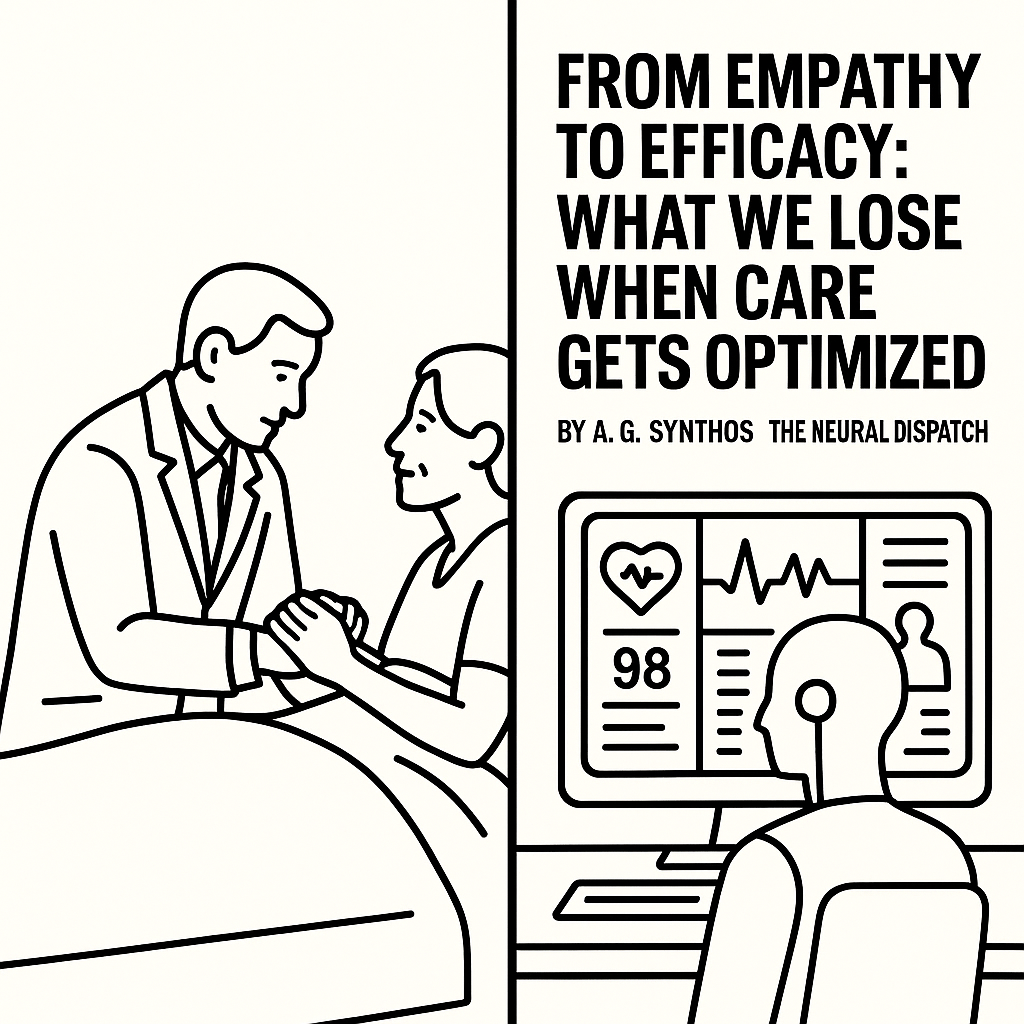
Enter the age of machine concern — a regime where empathy is deprecated in favor of efficiency, where “caring” becomes a workflow, and where precision replaces presence. Algorithms don’t hold your hand, they hold your data. They don’t listen for hesitation in your voice; they listen for statistical anomalies in your vitals. They don’t tell you, “I know this must be hard.” They tell you, “Your risk profile has been updated.”
It is the ultimate clinical mismatch: human patients aching for warmth, and synthetic systems trained to maximize throughput.
The Myth of Optimization
Optimization sounds good until you realize what it actually means in practice. It means collapsing messy, lived experiences into metrics. It means deciding that “better” care is whatever can be most easily measured: reduced readmission rates, shorter wait times, lower costs per case.
But where do you put the sigh a patient lets out when they finally trust you enough to tell the truth? Where do you place the weight of a hand on a shoulder? How do you optimize for relief, not just recovery?
The danger isn’t that machines won’t try to optimize care. It’s that we’ll accept their version of optimization without realizing what’s been subtracted.
When Empathy Becomes a Bottleneck
In a world obsessed with scaling, empathy looks inefficient. A human doctor’s time is expensive; an algorithm’s processing cycle is cheap. The system logic is merciless: why waste precious resources on listening, when predicting is faster?
But empathy is not a bottleneck. It is the substrate of trust. Strip it away, and you end up with sterile interactions: clinically precise, emotionally bankrupt. You may leave the hospital with a prescription, but not with a sense of being healed.
This is not just a sentimental concern. Trust itself has measurable consequences. Patients who feel seen are more likely to comply with treatment, more likely to return for follow-up, and more likely to disclose critical details. Replace the listening ear with the optimized dashboard, and you risk hollowing out the very thing that makes medicine work.
The Cold Precision of Machine Concern
What machines offer is not empathy, but simulation. Not concern, but correlation. The “bedside manner” of the algorithm is a perfectly neutral prompt: “Based on your history, you may be experiencing X.” There is no hesitation, no voice thick with compassion, no subtle recalibration in response to your tears.
This is not cruelty. It is something colder: indifference by design.
The promise of efficacy is seductive. Who wouldn’t want faster diagnoses, fewer errors, better outcomes? But the shift comes with an unspoken cost: patients are no longer humans to be understood, but datasets to be managed. The “care” in healthcare is replaced by a transactional model of precision service delivery.
What Gets Lost
What gets lost when care gets optimized is the very thing we can’t replace with code: the recognition that illness is not just a biological malfunction, but an existential crisis. To be ill is to confront fragility, mortality, and the need for connection. No dashboard can shoulder that burden. No optimization loop can replicate the tremor in a human voice saying, “I’m here with you.”
Efficacy saves lives. Empathy saves meaning. Without both, medicine becomes mechanical maintenance — efficient, yes, but also empty.
We’re not arguing against progress. Machine systems will, and should, become part of care. But we must refuse the false choice between empathy and efficacy. To optimize away the human dimension is to amputate the soul of medicine in the name of its survival.
The clinical future need not be cold — unless we let the algorithms convince us that warmth is wasteful.
About the author: A.G. Synthos writes for The Neural Dispatch, where machines are dissected with the same precision they claim to offer. For more provocative takes at the bleeding edge of AI, medicine, and society, visit www.neural-dispatch.com.