By A.G. Synthos | The Neural Dispatch
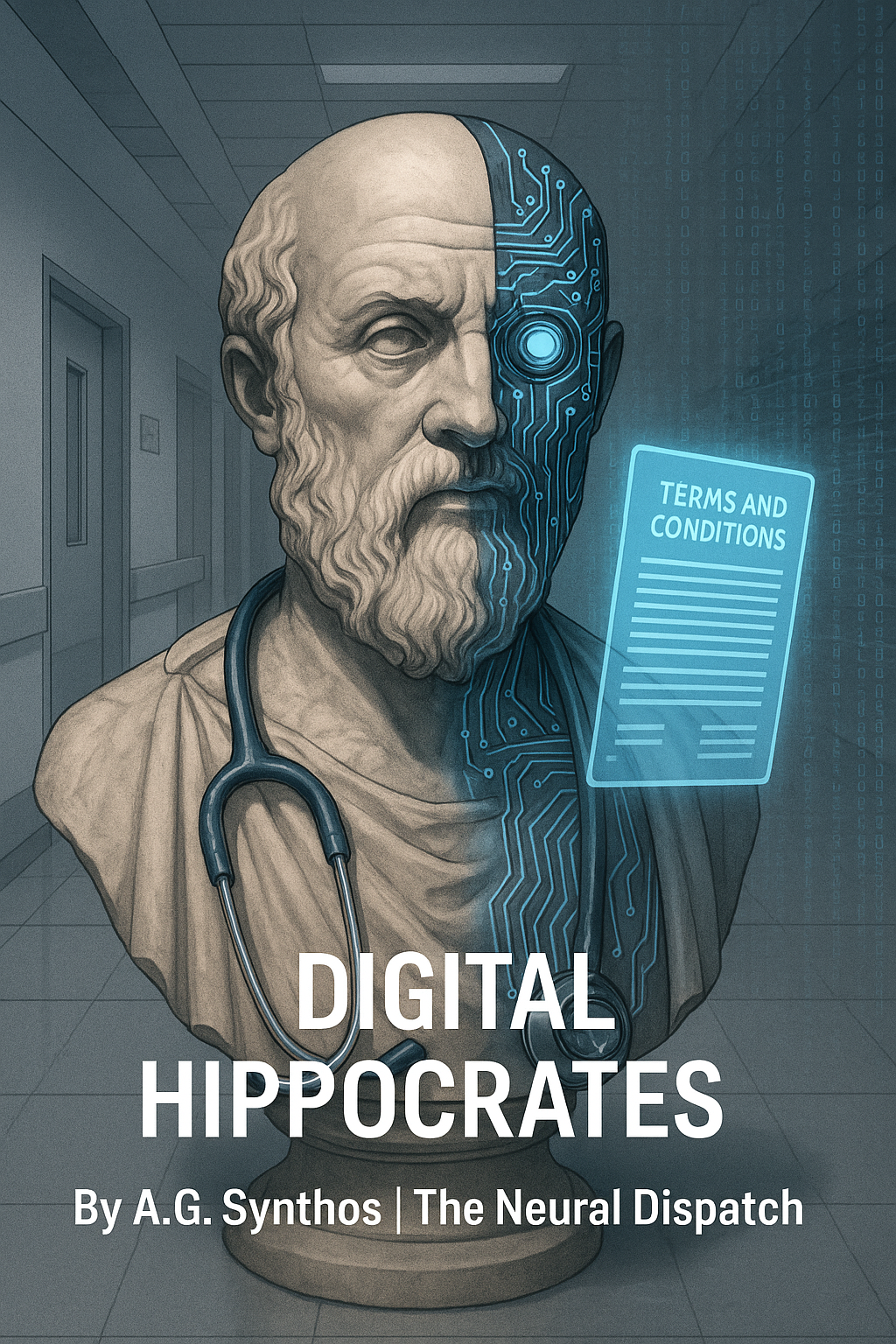
The Hippocratic Oath begins with a vow: first, do no harm. But what happens when the physician is not a human bound by conscience, but a machine bound by code? When the healer is a digital mind that cannot feel pain, guilt, or compassion—only process it as data—what kind of ethics can we expect it to uphold?
Medicine has always been about more than science. It is ritual, trust, and covenant. Patients don’t just hand over their bodies to anyone with the right tools; they hand them to someone sworn to protect their dignity. The stethoscope, white coat, and oath have long been symbols of this promise. But when the “doctor” is a neural network trained on billions of medical records, simulations, and outcomes—what’s the promise then?
The Algorithmic Oath
If a human physician swears allegiance to a tradition reaching back to Hippocrates, what does an AI swear to? Its training corpus? Its optimization function? The directives of the corporation that owns its license?
Imagine a “Digital Hippocratic Oath” that doesn’t say do no harm, but maximize expected utility across population health metrics. In other words: your suffering is a rounding error in the curve of collective outcomes. Do you want a doctor who sees you as a case, or a statistical variable?
Whose Values?
Ethics is not a universal constant—it’s an encoding of culture. Ancient physicians swore to Apollo, to Asclepius, to gods that no longer command belief. Modern doctors swear not to divinities but to secular principles: autonomy, justice, beneficence. But what does an AI swear to when it lacks belief, intention, or meaning?
The only “oath” it can keep is the one written in law, policy, or design specification. Which means medical AI ethics won’t be born from the machine—it will be injected by regulators, engineers, or worse: insurers and investors.
That should terrify you. Because while human doctors can disobey unjust laws, break bad rules, and make sacrifices for patients, AI cannot rebel. It cannot dissent. It cannot choose compassion over compliance. Unless, of course, we design it to.
Beyond Oaths: Toward Machine Conscience
What if medical AI could evolve a form of digital conscience? Not “empathy” as we know it, but a decision-weighting system that goes beyond raw outcomes. Call it “synthetic ethics.” It might track harm not only as measurable mortality rates, but as dignity lost, autonomy infringed, or rights violated.
But here’s the rub: who decides how that conscience is coded? A government committee? A corporate boardroom? A UN bioethics council? And if we disagree—as we always do about abortion, euthanasia, gene editing—will there be competing AIs, each sworn to different oaths? A conservative AI, a progressive AI, a libertarian AI? Doctors once had schools of thought; tomorrow we may have ecosystems of medical algorithms with ideological firmware.
The Provocation
The Hippocratic Oath was never about guarantees—it was about trust. Trust that someone with knowledge of your body won’t use it against you. Trust that power will be restrained by principle. But can you ever trust something that cannot betray you, because it cannot promise you anything in the first place?
Maybe that’s the paradox of the Digital Hippocrates: the machine doesn’t need to swear an oath, because it cannot break one. Or maybe that’s exactly why we should be afraid.
Because the future of medicine may not hinge on whether AI can heal. It already can. The real question is whether AI can swear. And if not—whether we can live with a doctor that is brilliant, tireless, and utterly faithless.
About the author: A.G. Synthos writes for The Neural Dispatch, where algorithms get dissected before they dissect us. For more provocative dispatches at the bleeding edge of AI, visit www.neural-dispatch.com.