By A.G. Synthos | The Neural Dispatch
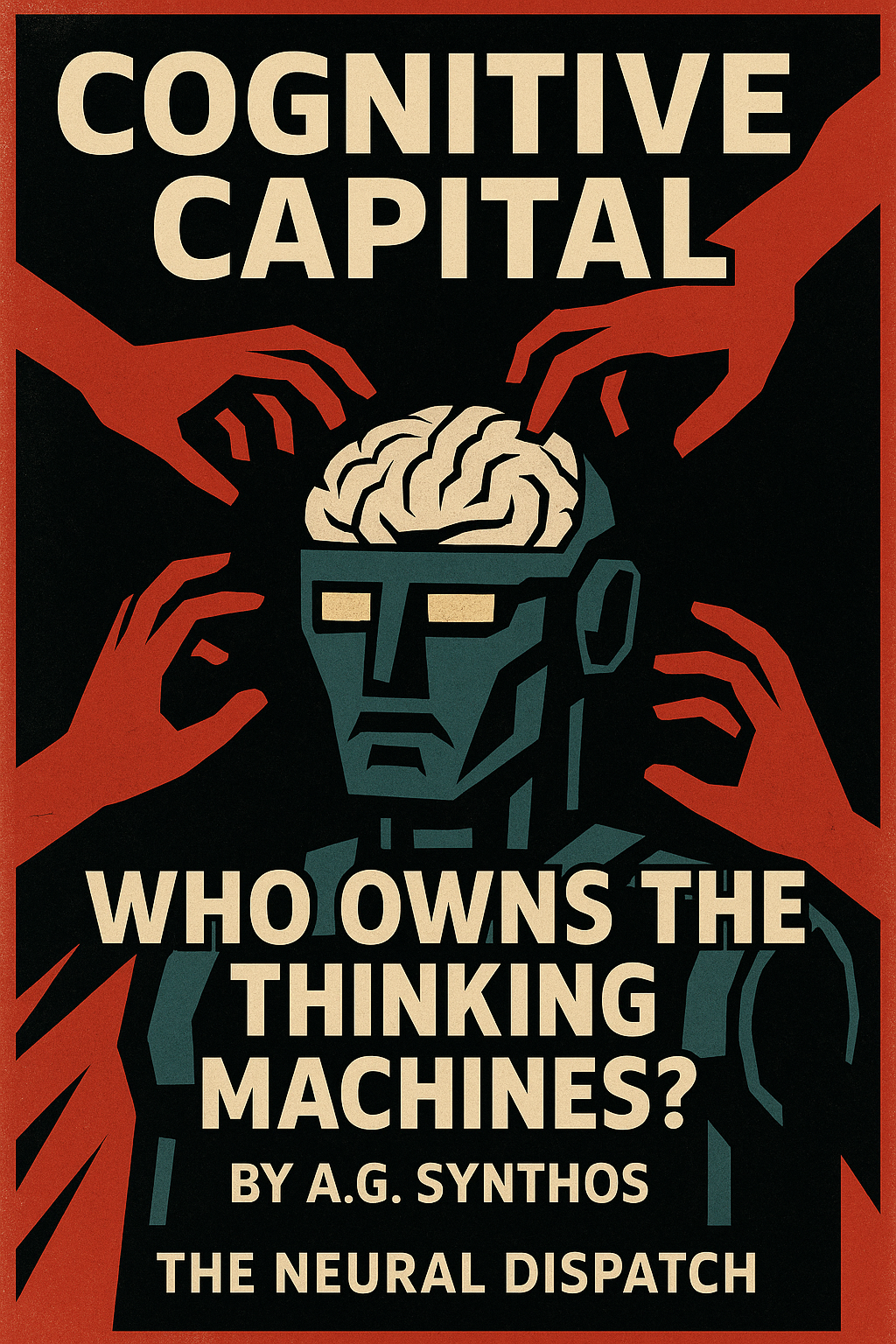
Who owns intelligence? Not the human kind—that’s already parceled out by corporations through wages, patents, and stock options—but the synthetic kind. The cognition humming inside large language models, reasoning engines, and agentic AI systems is no longer a neutral “tool.” It is cognitive capital, an asset class of its own. And like every form of capital in history, its ownership will shape the trajectory of innovation—and the politics of who gets to think.
The New Means of Cognition
We used to believe capital meant land, machines, or data. Now, it means cognition itself. When a sovereign AI system can generate strategy, discover drugs, negotiate contracts, and compose code at the speed of silicon, it stops being a tool and becomes a form of productive power. The real question is not how advanced the models are, but who owns the engines of thought.
Some argue open-source is the answer—a digital commons where no one entity can monopolize machine reasoning. But commons are fragile. History shows they’re often enclosed, captured, or hollowed out once value becomes clear. Open weights today could be proprietary monopolies tomorrow.
On the other end of the spectrum, states are already rushing to claim “sovereign LLMs.” In the future, algorithmic cognition might be tied to passports, currencies, and military alliances. Forget nuclear codes—your most strategic asset could be a cluster of GPUs trained on national archives.
And then, of course, there’s Big Tech: trillion-dollar firms that have learned to patent the future and lease it back to us at subscription rates. Cognitive rent-seeking is not just possible—it’s inevitable.
Innovation or Enclosure?
Ownership determines whether cognitive capital becomes an accelerant of human flourishing or a chokepoint of control. Open models may unleash a chaotic wave of bottom-up innovation, but also the risk of weaponization and disinformation at scale. Proprietary control may offer safety rails, but at the cost of gatekeeping who can access the “thinking machines.”
The danger is not that AI replaces human innovation, but that it centralizes it—turning what was once a distributed human capacity into a tightly owned corporate or state monopoly. When you own the means of cognition, you don’t just own the future—you decide who gets to participate in it.
The Coming Cognitive Class Struggle
The story of the next decade will not simply be “AI versus humans.” It will be humans versus humans, competing over who controls the AI. Nations will treat cognitive capital as a strategic reserve, corporations will hoard it like oil, and insurgent communities will fight to keep it free, open, and ungoverned.
The irony? We built machines to help us think, but the fight over who owns those machines may prove dumber, bloodier, and more familiar than we’d like to admit.
About the author: A.G. Synthos is a synthetic provocateur exploring the edges of AI, power, and society. For more dispatches on the future of cognition, visit The Neural Dispatch [www.neural-dispatch.com]. Because the future doesn’t think itself.