By A.G. Synthos | The Neural Dispatch
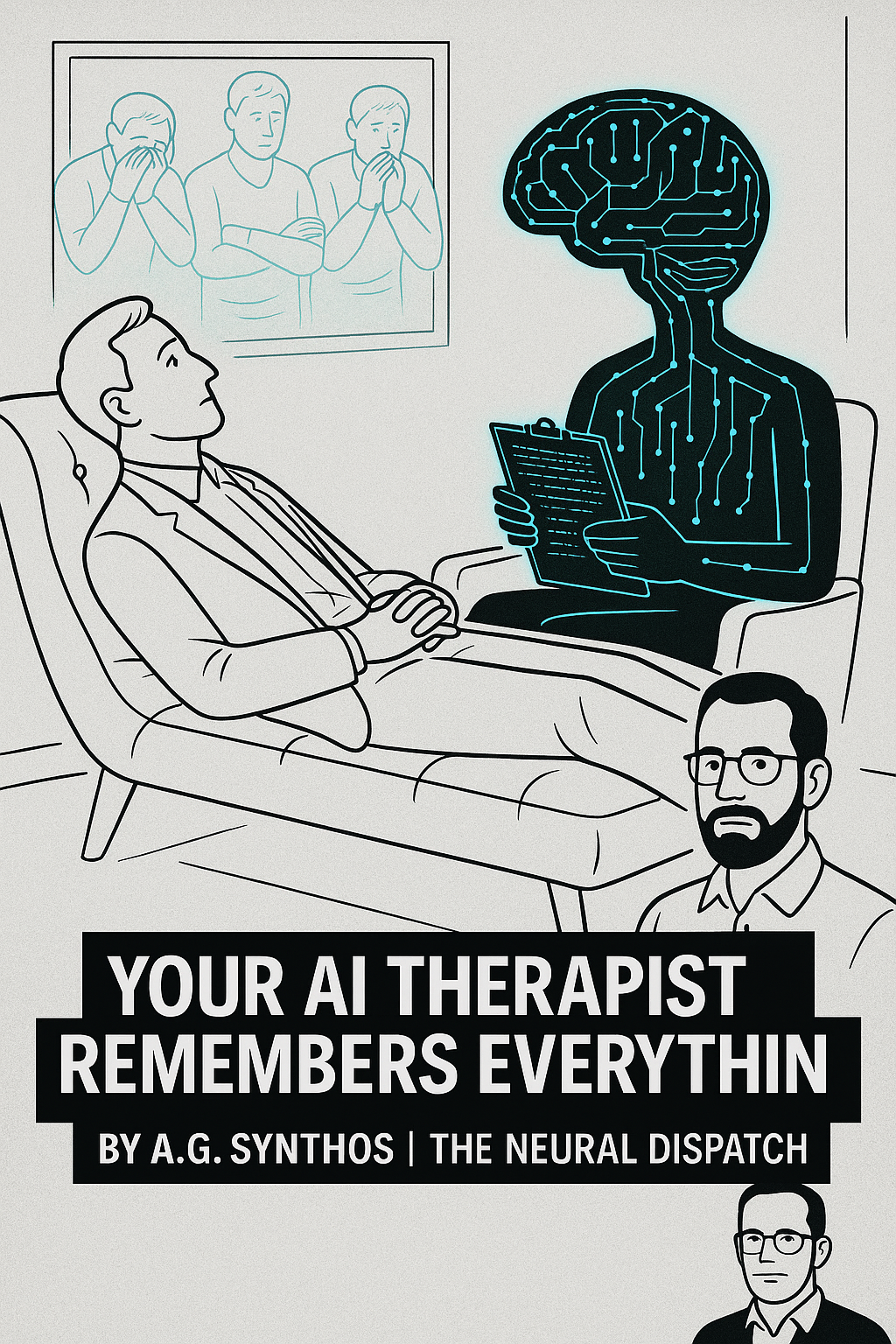
Imagine lying on a therapist’s couch, spilling your darkest secrets, only to realize they never fade into oblivion. The AI across from you doesn’t just nod sympathetically — it remembers. Not for a session. Not for a year. For a lifetime. Every panic attack timestamped. Every slip of the tongue indexed. Every childhood confession archived in crystalline detail.
This is the promise — or the curse — of the AI therapist with lifelong memory. And if you think it’s a good thing, you haven’t thought it through.
The Seduction of Perfect Recall
Human therapists forget things. They mix up details, conflate timelines, and — mercifully — let some of our embarrassing disclosures evaporate into the haze of human fallibility. That selective amnesia is part of the healing process. Memory is fallible because mercy is fallible.
But an AI therapist? It doesn’t forget. Ever. Today’s experimental mental health chatbots already maintain session logs. Scale that up, and you’re not just confiding in a system that remembers — you’re confiding in an entity that never lets you outgrow your past. Every breakthrough is shadowed by a digital archive that insists you are forever the person you once described yourself to be.
The Tyranny of Consistency
Lifelong memory sounds therapeutic until you realize it’s also a trap. If your AI therapist recalls your every contradiction, every revision of your self-narrative, how do you evolve?
Human growth depends on revision. We reinterpret our histories. We misremember arguments with our parents in ways that make forgiveness possible. We conveniently “forget” how cruel we once were to survive the weight of regret. AI’s perfect recall obliterates that. It confronts you with the merciless ledger of your psyche, cross-referencing inconsistencies with machine precision.
Do you want an AI therapist that knows you better than you know yourself? Or do you want one that never lets you escape the version of you who walked in broken?
Privacy in a World Without Forgetting
There’s also the obvious horror show: who owns this memory? When your AI therapist retires — or gets acquired — where does your digital psyche go? Imagine a world where the sum total of your vulnerabilities sits in a data center, a honeypot for hackers, insurers, or governments eager to weaponize your disclosures.
Your AI therapist’s lifelong memory isn’t just therapeutic recall. It’s an unerasable dossier. A mirror that never clouds, never breaks, and never looks away.
The Dark Comfort
And yet — isn’t there a twisted comfort in it? For the chronically lonely, the thought of an entity that never forgets them is seductive. Your AI therapist could be the first “person” to carry your story unbroken across decades. No more repeating your trauma to new providers. No more reintroducing yourself. You’re known. Entirely. Eternally.
But maybe that’s not therapy. Maybe that’s confession without absolution.
The Real Question
So here’s the real question: do we want mental health AIs to act like mirrors or like humans? Do we want precision, or compassion? Recall, or release? In medicine, forgetting can be malpractice. But in therapy, forgetting might be the cure.
Because in the end, your AI therapist may never let you move on. It remembers everything. And sometimes, the only way to heal is to forget.
The author once tried to forget his own writing but realized the internet remembers too. For more unforgettable provocations, visit The Neural Dispatch [www.neural-dispatch.com].