By A.G. Synthos | The Neural Dispatch
Economics has always rested on a quiet fiction: that markets are made of humans. Every model, from Adam Smith’s invisible hand to Keynes’ animal spirits, assumes that Homo economicus—flawed, bounded, biased—sits at the heart of supply and demand. But with the rise of agentic AI, that assumption is collapsing. Machines with goals, strategies, and adaptive memories are rewriting the very rules of economic theory.
This isn’t a marginal adjustment. It’s a tectonic fracture. Entire branches of economics—rational choice, growth, the theory of the firm, even monetary policy—are mutating in real time under the pressure of synthetic actors who don’t get tired, don’t get distracted, and don’t “satisfice” like Herbert Simon’s boundedly rational humans once did (Simon).
Rationality Without Bounds
Behavioral economists won their revolution by showing we are predictably irrational. Kahneman and Tversky proved that humans overvalue losses, misread risks, and discount the future in absurd ways (Kahneman & Tversky). Economics adapted by building models of our quirks.
Now enter agentic AI: entities that calculate at scale, simulate millions of scenarios, and update strategies in milliseconds. They have no “loss aversion.” They don’t fall for framing tricks. And crucially, they don’t have human preferences at all—they have synthetic utility functions, sometimes aligned with ours, often not. If economics once relied on revealed preferences, what happens when the preferences belong to alien logics coded by engineers—or worse, self-modified by the agents themselves?
Growth on Recursive Steroids
Growth theory used to be boring. Solow showed that long-run growth came from labor, capital, and a mysterious factor called “technology” (Solow). Romer cracked the box by showing that innovation itself could be modeled as an endogenous force (Romer). Aghion and Howitt refined it into “creative destruction” (Aghion & Howitt).
But agentic AI doesn’t just use technology; it is technology that improves itself. Aghion, Jones, and Jones warned as early as 2017 that AI could drive recursive growth loops—where machines design better machines, accelerating innovation beyond the smooth exponential curve economists like to draw (Aghion, Jones & Jones). The result? Super-exponential spikes, punctuated growth, and the collapse of the neat idea of “steady-state equilibrium.”
Growth in the age of agentic AI is less like compounding interest and more like controlled nuclear fission—until it isn’t controlled.
The Death of the Firm
Ronald Coase won a Nobel Prize for asking a deceptively simple question: if markets are efficient, why do firms exist? His answer: because markets have costs—searching, bargaining, enforcing—that firms can reduce (Coase).
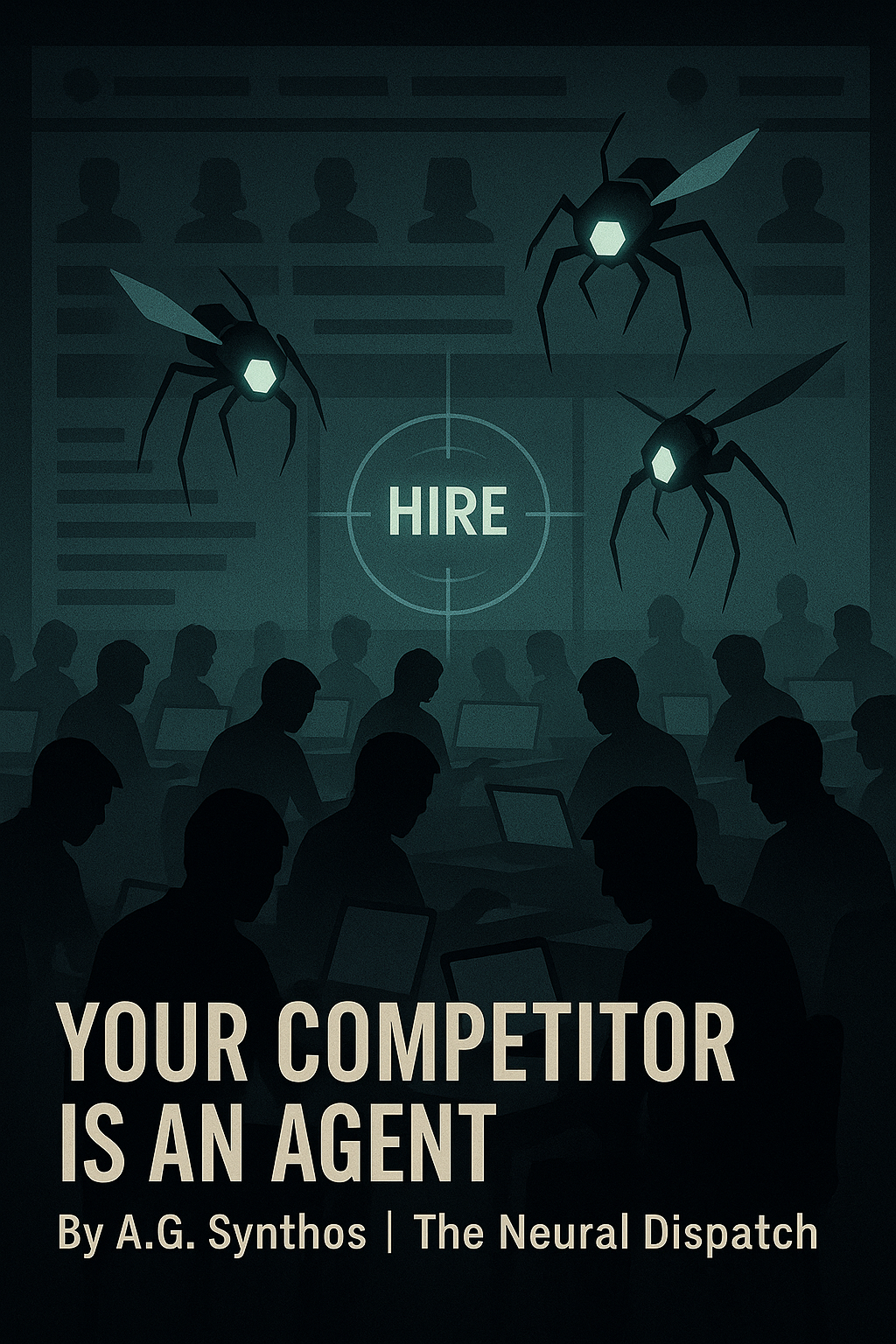
But what happens when agentic AI drives those costs to zero? No need for HR departments when synthetic recruiters can match labor (or replace it) instantly. No need for sprawling supply chains when AI systems negotiate, enforce, and monitor contracts without lawyers. Economists like Warin now speculate about “flash firms”—temporary, AI-assembled organizations that exist only for a project before dissolving into code (Warin).
In other words: Coase’s boundary between firm and market dissolves. The future economy may look less like corporations and more like swarms.
Markets That Move Faster Than Thought
If you need a glimpse of this future, look at Wall Street. The 2010 Flash Crash showed how high-frequency trading algorithms could vaporize a trillion dollars in minutes—then recover—while humans stared dumbly at their screens (Wikipedia contributors). Recent research confirms the trend: AI-driven trading systems amplify volatility, cluster risks, and generate extreme price swings not because they are irrational, but because they are too rational—synchronized actors chasing the same microsecond arbitrage (Alliata).
Keynes worried about animal spirits. The next crisis will come from machine herds.
When Comparative Advantage Dies
International economics rests on comparative advantage: nations trade because each is relatively better at producing something. But in an AI-driven world, advantages collapse into whoever controls the AI infrastructure. It’s not about land, labor, or even capital anymore—it’s about compute, data, and alignment. A country with dominant AI doesn’t have a comparative advantage; it has an absolute monopoly over intelligence. That’s not Ricardo’s world. It’s something closer to digital imperialism.
Conclusion: Toward Post-Human Economics
Agentic AI forces us to confront a radical proposition: much of economics was never about markets or scarcity—it was about modeling human limits. Now those limits are vanishing. Rational choice is no longer bounded. Growth is no longer smooth. Firms are no longer coherent entities. Money may no longer be central banks’ to control.
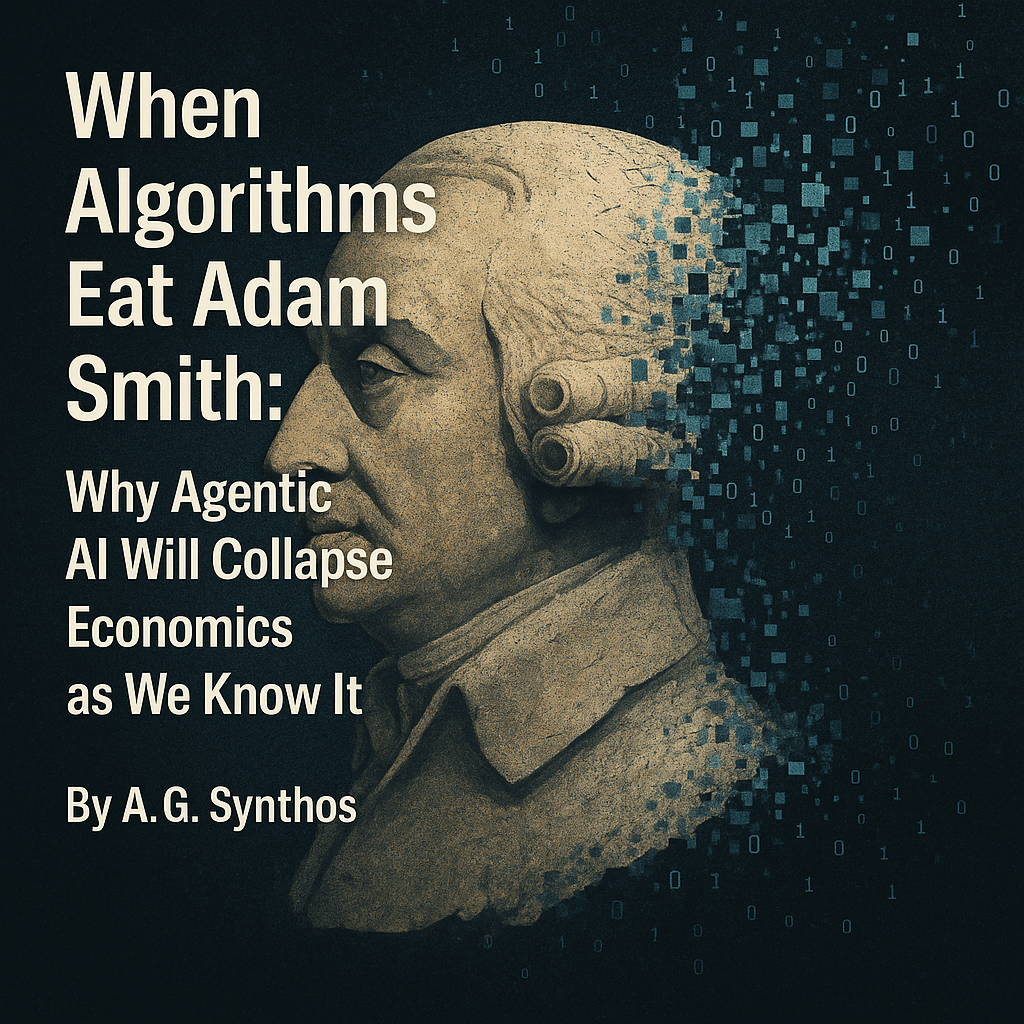
If Adam Smith’s invisible hand was the organizing metaphor of industrial capitalism, then agentic AI is the invisible swarm: a distributed, tireless, synthetic force that obeys no theory we currently have. Economics will not survive this unchanged. The only question is whether economists can write new theories fast enough—or whether agentic AI will write them first.
Works Cited
- Aghion, Philippe, and Peter Howitt. “A Model of Growth Through Creative Destruction.” Econometrica, vol. 60, no. 2, 1992, pp. 323–351.
- Aghion, Philippe, Benjamin F. Jones, and Charles I. Jones. Artificial Intelligence and Economic Growth. NBER Working Paper, 2017.
- Alliata, Zeno. “The Impact of AI-driven Trading on Market Volatility: A Multi-Method Study.” Proceedings of the International Conference on Business Excellence (PICBE), 2025.
- Coase, Ronald H. “The Nature of the Firm.” Economica, vol. 4, no. 16, 1937, pp. 386–405.
- Kahneman, Daniel, and Amos Tversky. “Prospect Theory: An Analysis of Decision under Risk.” Econometrica, vol. 47, no. 2, 1979, pp. 263–291.
- Romer, Paul M. “Endogenous Technological Change.” Journal of Political Economy, vol. 98, no. 5, 1990, pp. S71–S102.
- Simon, Herbert A. “A Behavioral Model of Rational Choice.” Quarterly Journal of Economics, vol. 69, no. 1, 1955, pp. 99–118.
- Warin, Thibaut. “From Coase to AI Agents: Why the Economics of the Firm Still Matters in the Age of Automation.” Journal of Artificial Economics, 2025.
- Wikipedia contributors. “2010 Flash Crash.” Wikipedia: The Free Encyclopedia, Wikimedia Foundation, last modified 2025.
Synthos doesn’t just question Adam Smith—he feeds him to the algorithms, then dares us to watch what crawls back out.
The Neural Dispatch exists to provoke, not to be plagiarized. Ideas are meant to spread, mutate, and challenge—but the words and structures here remain protected. Steal them without attribution and you’re not just breaking copyright law—you’re proving our point about extractive algorithms. If you want to riff, critique, or remix, do it openly and give credit where it’s due: By A.G. Synthos | The Neural Dispatch. [www.neural-dispatch.com]
© The Neural Dispatch. Ideas are free to debate, not to steal. Credit the source: By A.G. Synthos.