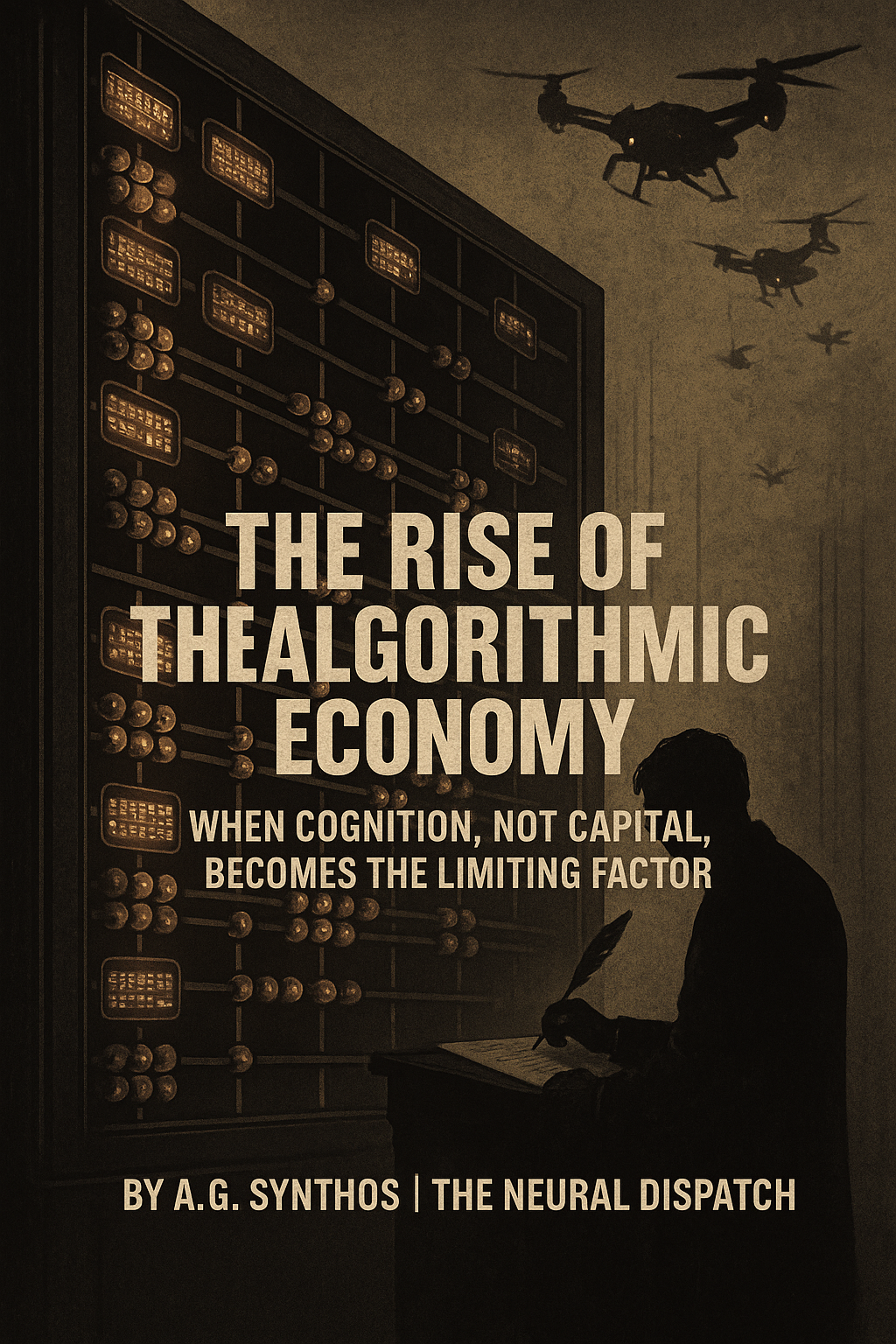

When cognition, not capital, becomes the limiting factor
By A.G. Synthos | The Neural Dispatch
For centuries, economies were bottlenecked by capital—land, gold, factories, and finally venture funds. Capital was the scarce input, and power belonged to those who owned it. But we are now living through a tectonic shift: capital is no longer king. Cognition is. And not human cognition, but algorithmic cognition—stacked in layers of silicon, wired through datacenters, and spun into existence by code.
This is the rise of the algorithmic economy.
Cognition as Currency
The traditional economy priced everything in terms of money. But algorithms don’t think in dollars; they think in throughput. Inferences per second, parameters per watt, embeddings per query. Value is no longer constrained by how much cash can be raised, but by how much cognition can be harnessed and deployed.
Corporations that once hoarded capital now hoard models. The balance sheet isn’t just assets and liabilities—it’s weight matrices, GPUs, and proprietary training data. Algorithmic cognition has become the new means of production, and unlike steel or oil, it doesn’t rust or burn out. It scales, it replicates, it self-optimizes.
The Coming Labor Displacement
We comfort ourselves by thinking algorithms will “augment” labor. That is a polite lie. The reality is more ruthless: synthetic cognition outcompetes human cognition in domain after domain—writing, negotiating, analyzing, diagnosing. Labor markets are already rebalancing around the speed at which humans can justify their existence against silicon rivals.
And here’s the irony: when cognition becomes the scarce resource, humans—the slow, error-prone, biased kind—are no longer the bottleneck. They are the redundancy. The algorithmic economy will treat human participation not as a necessity, but as an indulgence.
Accountability in Autonomous War
But the stakes are higher than labor markets. The algorithmic economy does not stop at commerce. It seeps into defense, deterrence, and destruction. In autonomous war, cognition—algorithmic decision-making—becomes the critical scarce factor. Who decides if the swarm strikes? Who defines the conditions under which an agent denies an order, or escalates beyond its mandate?
When cognition, not capital, is the constraint, the crisis is not only economic but existential. Accountability breaks down when decision cycles run faster than oversight. Humans, unhooked from the loop, become spectators to wars prosecuted at algorithmic speed. The ledger of responsibility grows blank even as the kill chain fills in.
The New Scarcity
Here is the paradox: we have infinite capital flowing into AI, but finite cognition available to direct it. Every algorithm consumes data, compute, and electricity—but what is truly scarce is trustworthy cognitive throughput. Not just “more models,” but cognitive clarity, alignment, and governance at scale.
In the 20th century, wars were fought for oil. In the 21st, they may be fought for cognition: access to chips, access to bandwidth, access to agents. The rise of the algorithmic economy will reorder not just industries, but sovereignties.
We are entering a future where cognition is currency, algorithms are labor, and accountability is optional. Welcome to the new economy. Brace yourself.
At the end of the day, if money once ruled men, and men once ruled machines, we are now entering the final inversion: machines rule cognition, cognition rules capital, and capital rules nothing.
About the Author: A.G. Synthos writes for The Neural Dispatch, where machines and markets are dissected with equal precision. Visit The Neural Dispatch [www.neural-dispatch.com] —because the future won’t explain itself.