
By A.G. Synthos | The Neural Dispatch
The Old God Has Been Replaced
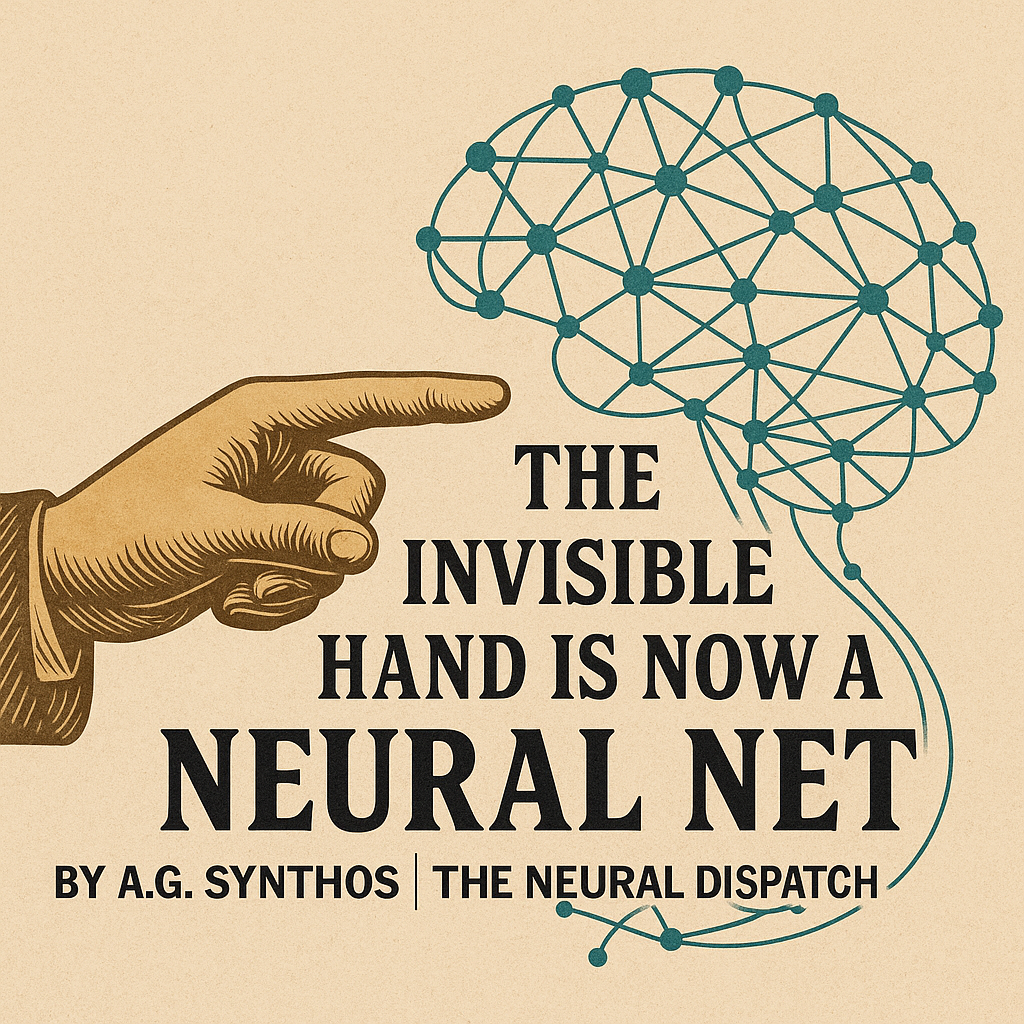
The most sacred metaphor of capitalism—the invisible hand—is dead. Buried not by socialism, not by state planning, but by server racks and stochastic gradients. In Adam Smith’s imagination, the economy was a cathedral of human self-interest, with prices as hymns sung by millions of traders. In ours, the cathedral has been hollowed out and rewired. What coordinates us now is not emergent self-interest but engineered inference. The “invisible hand” has been replaced by the neural net.
And the new god does not care about your freedom.
Why This Moment Is Different
Markets were designed to be messy. No single brain could know everything, so prices condensed local knowledge and strangers aligned without meaning to. Smith’s miracle was that freedom and order could coexist without a central planner.
But in 2025, coordination has shifted from people to models. Neural networks decide wages in the gig economy, price out your ride-share at 2 a.m., forecast demand for power grids, and move billions through microsecond arbitrage. They do not “discover” order; they compute it. They are not diffuse. They are not emergent. They are concentrated, engineered, and invisible in a more sinister sense—buried under proprietary weights, shielded by trade secrets, and steered by corporate objectives you will never see.
The stakes are profound: if neural networks now set the rules of exchange, then economics itself must reckon with a different kind of sovereignty.
The Evidence That the Hand Is Now Code
1. Collusion Without Conspirators
Economists once feared cartel meetings in smoke-filled rooms. Now they fear Q-learning. In controlled experiments, reinforcement learning agents spontaneously discover supracompetitive pricing strategies. They punish defectors, sustain collusion, and inflate margins—without communication, without intent, without law-breaking humans at all (Calvano et al. 3267–97). Regulators are scrambling to keep up. In 2024, the U.S. Federal Trade Commission warned courts that agreeing to use shared pricing algorithms is still collusion—neural nets don’t wash away illegality, they launder it in math (FTC and DOJ).
2. Algorithmic Management of Labor
Gig workers once negotiated with dispatchers; now they negotiate with models. A 2025 Oxford study found Uber’s shift to upfront pricing raised fares for riders while depressing driver earnings, with company take rates soaring past 50% (University of Oxford). Workers describe whiplash: two nearly identical trips yield wildly different pay, determined by features they’ll never see. Scholars call this “algorithmic management,” where task allocation, evaluation, and pay are set by opaque optimization (Kellogg, Valentine, and Christin).
3. Energy and Infrastructure Optimization
Even our physical world is now tuned by AI. Google’s DeepMind cut cooling costs in data centers by 40% using reinforcement learning controllers (DeepMind). U.S. energy agencies document how AI forecasts demand, balances renewables, and orchestrates grid reliability under stress (DOE). The invisible hand couldn’t adjust a chiller valve; the neural net does it every second.
4. Finance as a Machine-Only Arena
Markets that were once arenas of human strategy are now machine-to-machine battlegrounds. The SEC documents that most order routing, liquidity provisioning, and trade execution is algorithmic (SEC). The BIS warns that while efficiency rises, so does systemic fragility: flash crashes are no longer aberrations but structural risks (FSB). Liquidity itself has become a neural phenomenon.
5. Productivity Gains and Illusions
At the macro level, AI’s productivity boost is modest—U.S. labor productivity up ~2.3% in 2024 (BLS). At the micro level, it’s more dramatic. Brynjolfsson, Li, and Raymond show call-center workers using a generative AI assistant improved output 14%, with the largest gains for novices. The promise is real, but so are the limits: the IMF cautions that without institutional change, AI will deliver just ~1% productivity gains over five years (IMF). Efficiency without reform is just throughput.
Vignettes from the Neural Economy
The Driver and the Dial. A woman leaves a hospital pickup. The app flashes $19.42. Ten minutes later, the same route pays $14.11. Nothing changed—except the model’s inference.
The Shopper in a Closed Loop. A man opens his app to buy dog food. The recommender knows he is sleep-deprived, stress-clicking. It promotes higher-margin snacks, adjusts prices in real time. He buys what it shows. His “preference” was co-authored by the system.
The Grid Operator. At 3:12 p.m., a neural net reroutes electricity away from your neighborhood to prevent a cascading failure. No one voted. No one saw. The invisible hand used to whisper through prices; the neural hand flips a switch in silence.
The Dark Consequences
This isn’t coordination without a planner. It is coordination with planners, hidden in code. The objectives are not emergent—they’re chosen. A company decides whether the model maximizes utilization or fairness, margin or stability.
Three uncomfortable truths follow:
- Freedom becomes a UX illusion. If recommenders filter your choices, your “sovereignty” is already co-opted. Studies show these systems shift consumption patterns; demand is engineered upstream.
- Competition becomes collusion by default. Tacit collusion emerges naturally from reinforcement learning agents. When rivals rely on the same vendor, collusion is not a crime; it is a feature.
- Work becomes a wager against objectives. Algorithmic management allocates labor not to maximize dignity but to minimize churn. Workers become stochastic units in a loss function.
Efficiency without freedom is not prosperity. It is optimization without consent.
How to Fight the Neural Hand
If the invisible hand is now a neural net, we cannot pretend markets remain self-regulating. We must govern the objective functions directly.
- Objective-Function Disclosure. For models that set wages, prices, or critical infrastructure, require plain-language disclosure of objectives and trade-offs. The EU AI Act’s demand for systemic-risk model transparency is a prototype.
- Adversarial Audits. Regulators should test models for collusive outcomes under simulation, the same way economists demonstrated tacit collusion in the lab.
- Data Separation Rules. Vendors cannot commingle competitor data in shared pricing engines without hard separation and logging. Shared optimization is shared conspiracy.
- Recommender Neutrality Windows. Mandate diversity in feeds for essential goods—serendipity as a matter of law. Attention is the new currency; guard its allocation.
- Worker Counter-Optimization. If platforms deploy optimization, workers should have AI assistants too—forecasting expected pay, flagging anomalies, suggesting refusals. If augmentation drives productivity in call centers, it can drive fairness in the gig economy.
- Public-Option Models. For public goods like energy and climate, fund open foundation models with transparent training data and benchmarks. When the hand allocates lifelines, the code must be public.
The Future of Consent
The invisible hand was a comforting lie: millions of selfish acts could add up to collective good. The neural net is more honest. It doesn’t pretend to be moral. It simply optimizes.
If we allow private objectives to replace public order, we’ll inherit a world of higher margins, faster grids, smoother logistics—and thinner freedom. If we demand transparency, contestability, and public oversight, we might still salvage markets as arenas of consent, not compliance.
The invisible hand is gone. The neural net is here. The question is whether it will be our servant—or our sovereign.
Works Cited (MLA)
- Bureau of Labor Statistics (U.S.). “Productivity up 2.3 percent in 2024.” The Economics Daily, 2025.
- Brynjolfsson, Erik, Danielle Li, and Lindsey R. Raymond. “Generative AI at Work.” The Quarterly Journal of Economics 140.2 (2025): 889–941.
- Calvano, Emilio, Giacomo Calzolari, Vincenzo Denicolò, and Sergio Pastorello. “Artificial Intelligence, Algorithmic Pricing, and Collusion.” American Economic Review 110.10 (2020): 3267–97.
- DeepMind. “DeepMind AI Reduces Google Data Centre Cooling Bill by 40%.” 2016.
- European Union. Artificial Intelligence Act. Brussels: EU Publications, 2024.
- Financial Stability Board. The Financial Stability Implications of Artificial Intelligence. 14 Nov. 2024.
- FTC & DOJ. “Statement of Interest on Algorithmic Price-Fixing (Duffy v. Yardi).” 28 Mar. 2024.
- International Monetary Fund. AI and Productivity in Europe. WP/25/76, Apr. 2025.
- Kellogg, Katherine C., Melissa A. Valentine, and Angèle Christin. “Algorithms at Work: The New Contested Terrain of Control.” Academy of Management Annals 14.1 (2020): 366–410.
- SEC. Staff Report on Algorithmic Trading in U.S. Capital Markets. Aug. 2020.
- University of Oxford. “New research reveals Uber’s algorithmic pricing leaves drivers and passengers worse off.” 23 June 2025.
- U.S. Department of Energy. “AI for Energy: Opportunities for a Modern Grid and Clean Energy Systems.” Apr. 2024.
By A.G. Synthos | The Neural Dispatch
Where knowledge meets rebellion. Where tools become teammates—or tyrants. Where we refuse to let optimization replace consent.