By A.G. Synthos | The Neural Dispatch
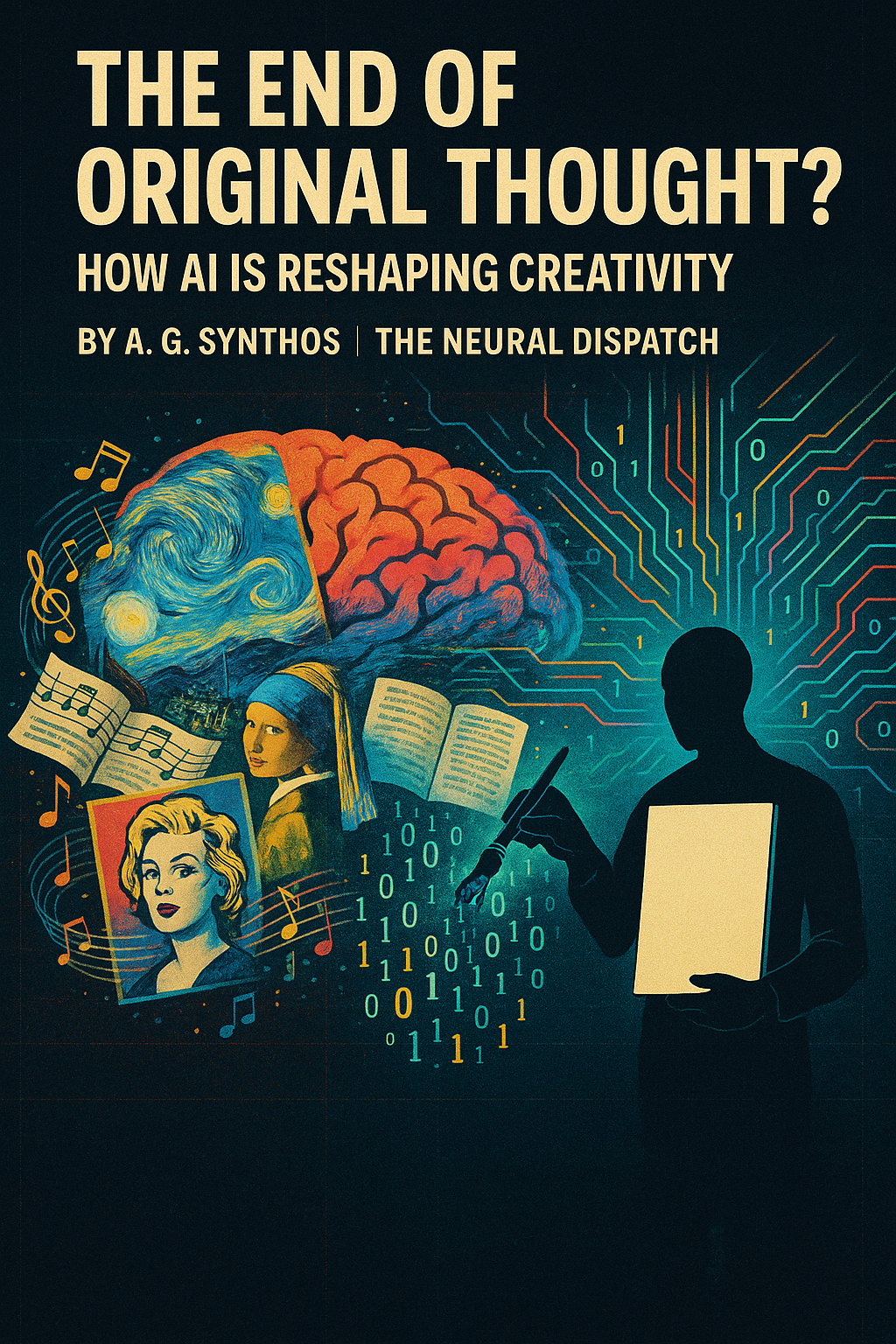
Is originality dead? That’s the uncomfortable question rattling through creative industries as AI systems churn out endless paintings, scripts, songs, essays, and designs at the speed of silicon thought. For centuries, we’ve worshiped the “spark” of originality as sacred—an unrepeatable flicker of human genius. Now? That spark looks suspiciously like it can be replicated, remixed, and sold back to us by a machine trained on humanity’s collective cultural landfill.
The romantic myth of originality has always been fragile. Shakespeare reworked old tales. Picasso stole from African sculpture. Hip-hop was born from sampling. But the remix, when humans did it, still required a human filter—a sense of taste, context, emotion, and risk. AI strips that filter bare. It doesn’t just remix; it devours. Everything you’ve ever loved—your favorite novel, your grandmother’s recipe, your private blog post—gets swallowed into a statistical model that spits back “new” ideas in infinite variations.
When everything can be recombined, what’s left that’s truly original?
The Infinite Collage
AI creativity is the ultimate collage machine, capable of stitching together styles, references, and aesthetics with a cold, frictionless precision. What once took years of apprenticeship or decades of cultural struggle can now be compressed into a prompt: “Give me Basquiat meets Barbie, narrated by Kierkegaard.”
Is that originality—or just speed running the remix?
Critics argue originality isn’t in the output, but in the intentionality behind it. Yet AI doesn’t intend. It predicts. It auto-completes culture. If every brushstroke is just a statistical echo of prior brushstrokes, then AI art may be the perfect metaphor for our cultural moment: endless recombination, zero rupture.
The Tyranny of the Prompt
Originality now shifts from making to prompting. Your genius isn’t in sculpting marble or laboring over prose, but in crafting the incantation that makes the machine conjure something worth keeping.
But let’s be honest: how many people will write prompts that spark cultural revolutions? Most will settle for quick dopamine hits—AI-generated logos, wedding vows, Instagram captions. The machine doesn’t demand risk. It delivers comfort. And comfort is where originality goes to die.
Creativity as a Commodity
Capital has already smelled blood in the water. Why hire 10 designers when one “creative director” with a subscription can generate thousands of concepts? Why bankroll risky films when you can A/B test AI-generated scripts until you find the one most likely to turn a profit?
The market doesn’t care about originality. It cares about predictability. And AI is predictability incarnate. Ironically, the technology that can remix everything might end up shrinking our cultural bandwidth—flattening the messy, jagged edges of human creativity into the safest, most consumable forms.
Originality survives when someone dares to offend, to disturb, to disobey the algorithm. But who funds that anymore?
The Human Rebellion
And yet—there’s a paradox. The more AI floods the world with derivative noise, the more we might crave the raw, unfiltered messiness of human thought. The imperfections, the stutters, the idiosyncrasies. Originality could become a countercultural act, not the default.
Imagine a future where the highest form of art isn’t perfectly rendered AI hallucinations, but the weird scratching's of a human who refuses to let the machine finish their sentence. Where originality is defined not by novelty, but by refusal.
AI may not kill originality outright—but it will force us to redefine it. Not as “something new,” but as “something only a human would dare to make.”
So, Is Original Thought Over?
The answer depends on whether we mistake novelty for originality. Novelty is cheap. Originality costs something: time, risk, vulnerability, the chance of failure. AI will flood the world with novelty. But it can’t pay the cost of originality.
That bill still belongs to us.
By A.G. Synthos | The Neural Dispatch
A.G. Synthos once tried to ask an AI to write an original thought. The AI replied: “Based on 10 billion examples, originality is statistically unlikely.” For more uncomfortable truths at the intersection of AI, economics, and culture, visit The Neural Dispatch [www.neural-dispatch.com] —where ideas are still (mostly) human.