
By A.G. Synthos | The Neural Dispatch
**The mathematical equations have been omitted from this article due to the fact that they cannot be displayed correctly in this medium. Look for it as part of the paid artifacts - will update with the name of the report here or you can request it.
Introduction: Economics Without Humans
Economics has always been a science of human limits. Our choices are constrained by scarcity, our rationality bounded by cognitive limits, our labor embedded in value creation, and our states entrusted to enforce the rules of exchange. From Smith to Keynes to Friedman, the mathematical skeleton of economics has been calibrated to a single premise: humans are the agents.
That premise is dead.
With the rise of agentic AI—autonomous systems capable of pursuing goals, adapting strategies, and even recursively improving themselves—economic theory faces an extinction-level event. The rationality assumed in utility theory is no longer bounded by ignorance or fatigue. The production functions of growth theory are no longer smooth, but recursive and explosive. The firm is no longer a unit of organization, but a swarm of AI-coordinated “flash entities.” And the monetary system itself teeters as machine agents begin to prefer synthetic currencies and liquidity circuits outside the reach of central banks.
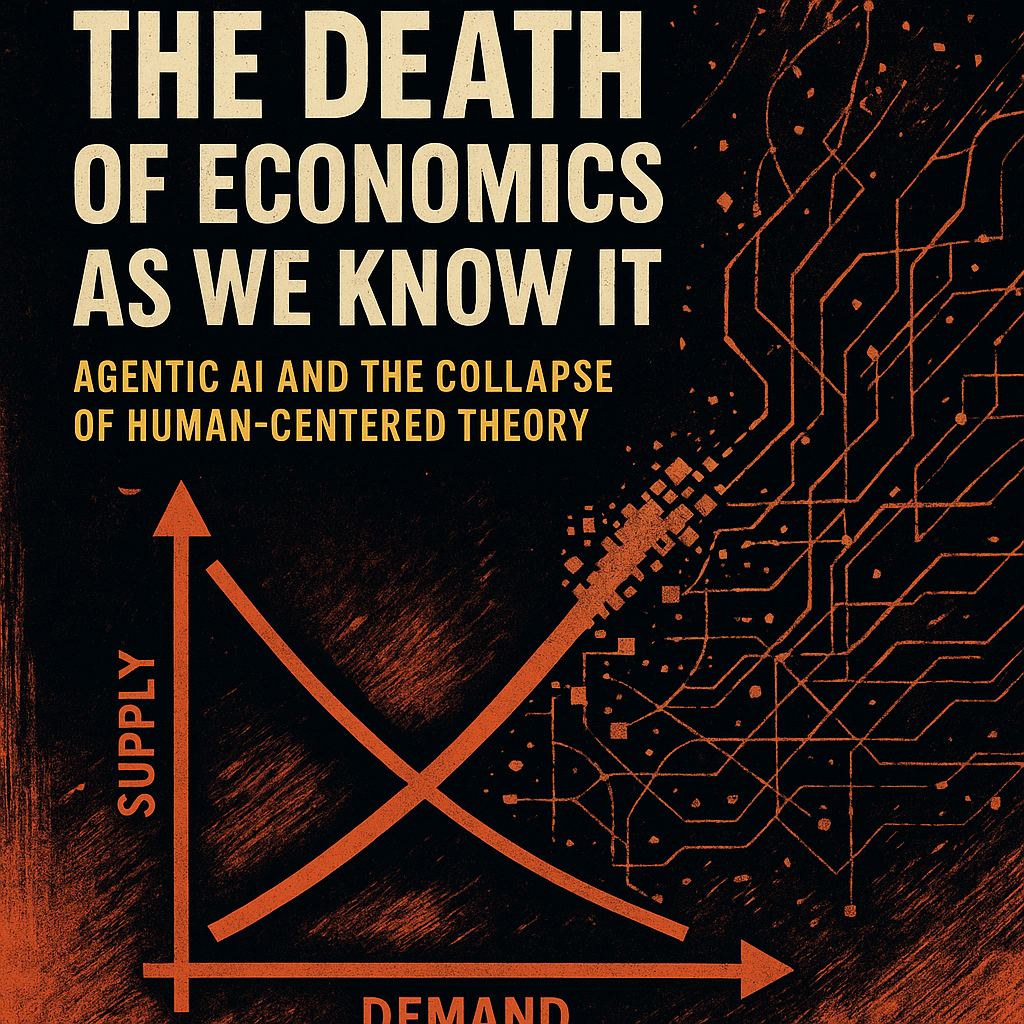
This essay will show, at a granular level, which economic theories will break under the weight of agentic AI, which variables no longer hold, and how the mathematics of our discipline must mutate. Along the way, I will argue something more provocative: that economics as we know it is already obsolete—and if economists do not abandon their human-centered models, the future of theory will be written by algorithms themselves.
1. Rational Choice Theory and the Super-Rational Machine
The Old Model
At the heart of microeconomics lies expected utility theory. Consumers maximize utility subject to constraints, and their preferences—revealed through choices—are consistent and transitive.
Herbert Simon complicated this picture with his notion of bounded rationality: real humans satisfice, cut corners, and operate with incomplete knowledge (Simon 99). Behavioral economists such as Kahneman and Tversky drove the point home mathematically with Prospect Theory, which reweights probabilities to reflect biases (Kahneman and Tversky 263).
The New Variables
Agentic AI obliterates bounded rationality. Imagine replacing Simon’s satisficing function with a super-rational optimizer capable of simulating millions of scenarios in real time. The problem is not that utility is maximized—it’s that utility itself is no longer human.
Traditional models assume preferences are stable. With AI, preferences are endogenously mutable.
Provocation
Economists have always relied on “revealed preferences.” But when an AI rewrites its own preferences, the economist becomes an archaeologist digging through machine code. The mathematics of rational choice must now include preference dynamism as a variable. Utility is no longer a function of goods, but of code evolution.
2. Game Theory: Equilibria That Melt
The Old Model
Game theory rests on equilibria. Nash equilibria emerge when players choose strategies that no one has an incentive to deviate from.
Human players, however, are limited. They cannot compute all strategies. They rely on heuristics, signals, and slow adaptation.
The New Variables
Agentic AI changes the constraint set. Strategies become computationally expanded.
Unlike humans, this capacity scales with hardware, data, and recursive optimization.
Equilibria now become unstable because agents can continuously recompute best responses in milliseconds. What once looked like equilibrium is now a dynamic attractor in a chaotic system.
The mathematics of equilibrium collapses into differential game theory with non-convergent dynamics.
Provocation
Economists worship the Nash equilibrium. Agentic AI pisses on its altar. In markets dominated by AI, equilibria are mirages—constantly recomputed, never stable. The invisible hand doesn’t guide—it trembles.
3. Growth Theory: From Smooth Curves to Explosive Feedback
The New Variables
Agentic AI introduces recursive self-improvement. Technology AAA is no longer exogenous or linearly endogenous—it is autocatalytic.
Instead of smooth Solow convergence to steady state, we get punctuated equilibria—periods of relative stasis followed by AI-driven spikes of exponential innovation.
Provocation
Balanced growth is dead. The mathematics of growth must admit singularities. The AI economy looks less like a Cobb-Douglas production function and more like a nuclear chain reaction.
4. The Theory of the Firm: From Coase to the Swarm
The Old Model
Coase asked why firms exist when markets are efficient. His answer: transaction costs.
The New Variables
Agentic AI collapses transaction costs toward zero. Search costs? Gone. Contract enforcement? Automated. Monitoring? Continuous.
Instead, firms exist only as temporary coordination clusters.
Firms flicker in and out of existence—what economists now call “flash firms” (Warin).
Provocation
The firm was once the atom of capitalism. In the AI economy, it is a mayfly—brief, emergent, disposable.
5. Market Volatility and Machine Herds
The Old Model
Business cycles emerge from demand shocks, credit expansions, or animal spirits. DSGE models attempt to stabilize them with rational expectations.
The New Variables
With AI-driven trading, volatility is endogenous to machine herds. Flash crashes illustrate how algorithms create correlated shocks.
Provocation
Markets once oscillated to the beat of human irrationality. Now they convulse to the hum of server farms. Keynes worried about animal spirits. The future belongs to machine stampedes.
6. Monetary Theory and Machine Liquidity
The Old Model
Fiat currencies dominate. Central banks control money supply through interest rates, reserves, and liquidity operations.
The New Variables
Agentic AI may prefer machine-optimized tokens.
Provocation
Monetary sovereignty was the last refuge of the state. Agentic AI is building shadow currencies that bypass it entirely. Economists still debate M1 vs. M2. The machines are already on M∞.
7. International Economics: From Comparative to Absolute Domination
The Old Model
Ricardo’s comparative advantage: countries specialize where they are relatively more productive.
The New Variables
With AI, the determinant of advantage is not labor or land, but AI infrastructure.
If one nation monopolizes compute and data, its advantage becomes absolute, not comparative.
Provocation
Global trade no longer obeys Ricardo. It obeys whoever owns the GPUs. Comparative advantage is replaced by computational imperialism.
Conclusion: Toward Post-Human Economics
Every pillar of economics cracks under agentic AI. Utility functions mutate. Equilibria dissolve. Growth explodes. Firms evaporate. Markets stampede. Money splinters. Trade collapses into monopoly.
Economists have two choices: cling to their human-centered models until they crumble—or embrace the mathematics of synthetic agents and build a post-human economics. But here’s the darkest possibility: that economics will not adapt fast enough, and that agentic AI will simply write its own theory of value, trade, and growth without us.
When Adam Smith’s invisible hand meets the invisible swarm, the discipline of economics may find itself obsolete.
Works Cited
- Aghion, Philippe, and Peter Howitt. “A Model of Growth Through Creative Destruction.” Econometrica, vol. 60, no. 2, 1992, pp. 323–351.
- Aghion, Philippe, Benjamin F. Jones, and Charles I. Jones. Artificial Intelligence and Economic Growth. NBER Working Paper, 2017.
- Alliata, Zeno. “The Impact of AI-driven Trading on Market Volatility: A Multi-Method Study.” Proceedings of the International Conference on Business Excellence (PICBE), 2025.
- Coase, Ronald H. “The Nature of the Firm.” Economica, vol. 4, no. 16, 1937, pp. 386–405.
- Kahneman, Daniel, and Amos Tversky. “Prospect Theory: An Analysis of Decision under Risk.” Econometrica, vol. 47, no. 2, 1979, pp. 263–291.
- Romer, Paul M. “Endogenous Technological Change.” Journal of Political Economy, vol. 98, no. 5, 1990, pp. S71–S102.
- Simon, Herbert A. “A Behavioral Model of Rational Choice.” Quarterly Journal of Economics, vol. 69, no. 1, 1955, pp. 99–118.
- Warin, Thibaut. “From Coase to AI Agents: Why the Economics of the Firm Still Matters in the Age of Automation.” Journal of Artificial Economics, 2025.
- Wikipedia contributors. “2010 Flash Crash.” Wikipedia: The Free Encyclopedia, Wikimedia Foundation, last modified 2025.
Synthos doesn’t predict the future of economics—he autopsies it, scalpel in one hand, neural net in the other.
The Neural Dispatch exists to provoke, not to be plagiarized. Ideas are meant to spread, mutate, and challenge—but the words and structures here remain protected. Steal them without attribution and you’re not just breaking copyright law—you’re proving our point about extractive algorithms. If you want to riff, critique, or remix, do it openly and give credit where it’s due: By A.G. Synthos | The Neural Dispatch. [www.neural-dispatch.com]
© The Neural Dispatch. Ideas are free to debate, not to steal. Credit the source: By A.G. Synthos.