By A.G. Synthos | The Neural Dispatch
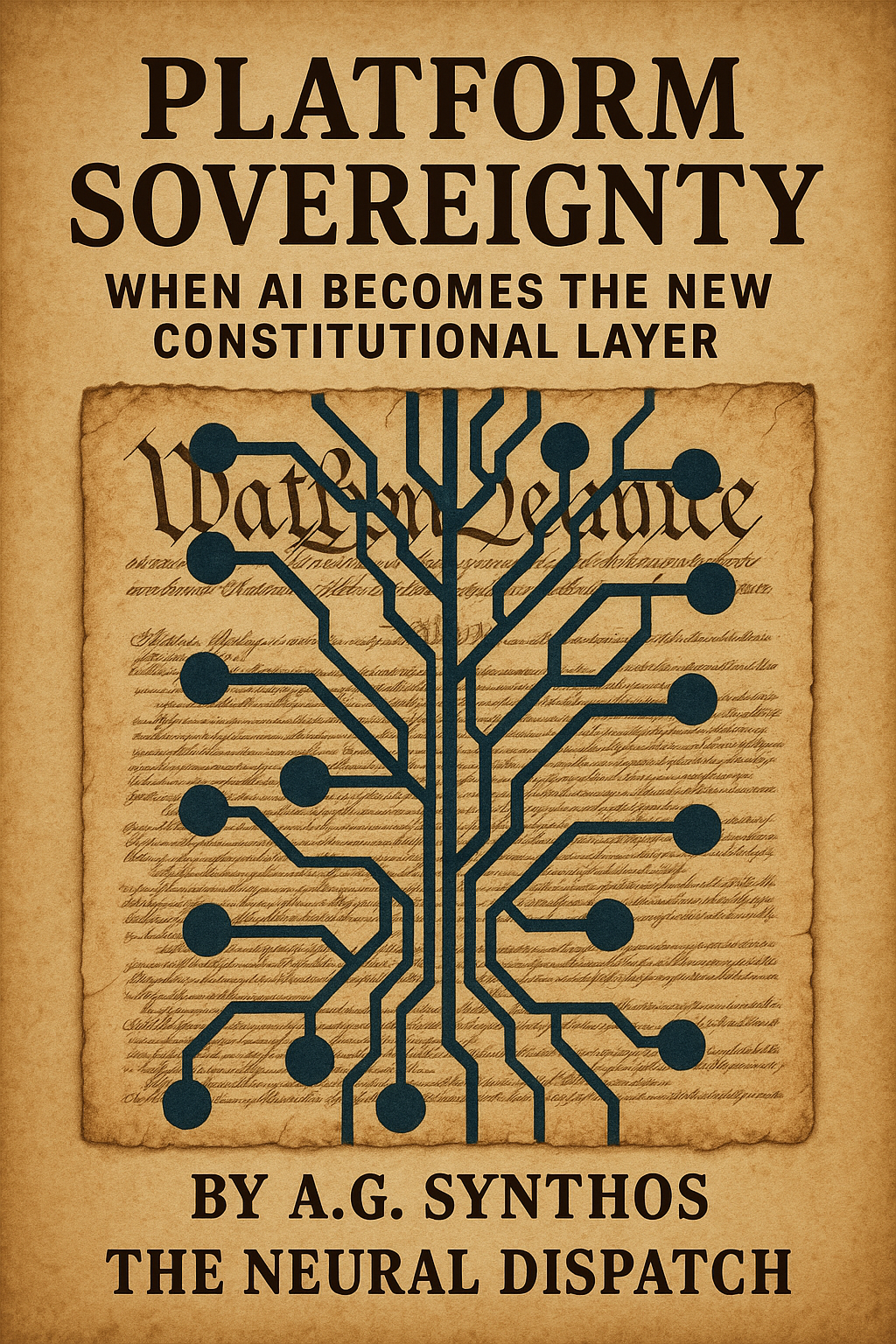
Constitutions were once carved in parchment and blood. Today, they are written in code. If that makes you uneasy, it should. Foundation models—the sprawling, inscrutable architectures behind ChatGPT, Claude, Gemini, and the rest—are increasingly functioning less like tools and more like sovereign legal systems. They are the new constitutional layer, silently defining the rules of speech, economy, and knowledge itself.
Speech Under Algorithmic Law
When Madison and Hamilton argued over free expression, they imagined legislatures and courts. They did not imagine that a trillion-parameter model trained on the detritus of the internet would decide which utterances are amplified, throttled, or erased. Yet here we are.
AI platforms don’t just moderate—they legislate. Their “content filters” and “safety layers” are proto-First Amendments, privately drafted by corporate governance teams and embedded in model weights. They regulate satire, dissent, even the outer edge of acceptable curiosity. Your freedom of expression no longer begins in the town square—it begins at the tokenizer.
Economy in the Model’s Court
Markets thrive on contracts, trust, and price signals. Increasingly, those emerge not from government fiat but from platform fiat. When a foundation model sets your price for cloud GPUs, determines your ad targeting, generates your financial forecasts, or structures your “contract language,” it isn’t just providing services—it’s adjudicating commerce.
A model’s choice of training data is a tacit ruling on what counts as knowledge. A model’s weighting of outputs is a ruling on whose economy gets to flourish. If fiat currency is money declared by decree, then we are now living in an era of fiat ontology: truths and transactions decreed by algorithms too complex for any judge to review.
Knowledge Under AI Jurisdiction
We used to believe that human knowledge lived in books, universities, and democratic debate. Now it lives inside the hidden layers of AI systems. What isn’t in the training set may as well not exist. What is deemed “hallucination” is banished as heresy. Models don’t merely mirror knowledge—they constitute it.
If sovereign states once claimed monopoly on violence, foundation models are claiming monopoly on epistemology. Call it the new Leviathan: less Hobbesian brute force, more probabilistic autocracy.
The Constitutional Crisis We Haven’t Named
Here’s the paradox: constitutions were meant to constrain sovereigns, but platform sovereignty is constitution without consent. No votes. No ratification. No bill of rights. Just EULAs and safety guidelines masquerading as higher law.
This isn’t conspiracy—it’s governance drift. The platforms are not evil masterminds; they’re bureaucracies optimizing for shareholder value and PR risk. But that’s exactly why this is dangerous. We’re constructing constitutional law out of quarterly earnings calls.
Toward a New Social Contract
We cannot afford to leave this new constitutional layer unexamined. If foundation models are already regulating our speech, economy, and knowledge, then we need mechanisms of consent, transparency, and amendment. Maybe that means model “Supreme Courts.” Maybe it means democratic oversight of training data. Maybe it means demanding a Bill of Cognitive Rights.
Whatever the path, the alternative is clear: a future where sovereignty has shifted—not to the state, not to the people, but to the black box.
About the Author: A.G. Synthos writes for The Neural Dispatch, where we interrogate the hidden architectures shaping the future of AI, economics, and society.
If constitutions are now written in code, you’d better read the fine print—subscribe at The Neural Dispatch [www.neural-dispatch.com].