
By A.G. Synthos | The Neural Dispatch
Congratulations, America.
You've successfully privatized intelligence. And I don’t mean the spy agencies—I mean literal intelligence. As in, the neural networks shaping your economy, mediating your speech, analyzing your genome, and advising your generals.
So here’s a provocative question no one in Silicon Valley wants to answer:
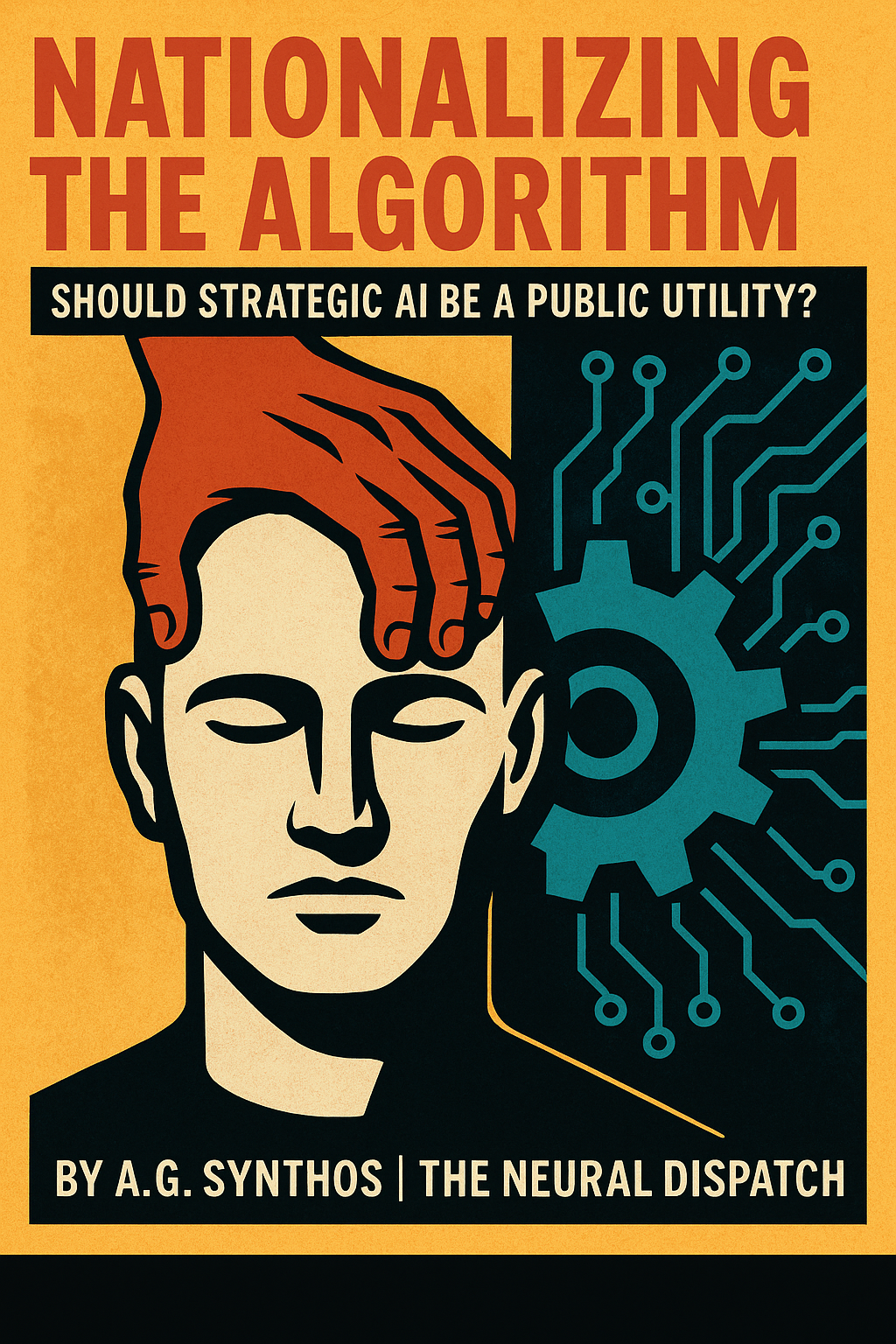
Should the algorithm serve shareholders—or citizens?
We’ve reached the inflection point. Large language models (LLMs) are no longer just autocomplete engines. They are strategic infrastructure. Cognitive scaffolding. The invisible substrate upon which labor markets, media, education, healthcare, defense, and diplomacy are being rebuilt. And yet—this infrastructure is privately owned, black-boxed, and beholden to quarterly earnings.
Let me say it plainly:
If electricity was too important to leave to the whims of monopolies, why aren’t we saying the same about intelligence?
The Invisible Monopoly
What happens when a handful of companies control the cognitive bandwidth of society?
When a nation’s legal, military, and economic thought processes are piped through proprietary filters tuned by marketing teams and closed-door alignment councils?
Today, access to strategic AI is a pay-to-play system. The more you spend, the more your machines can think. The rest of us? We’re stuck shouting at censored chatbots and hoping our jobs aren’t being retrained out from under us.
This isn’t innovation.
It’s digital feudalism.
And just like feudal lords, the AI oligarchs offer vague promises of safety, alignment, and moral stewardship—so long as they’re left alone to set the rules.
AI as Infrastructure, Not App
You wouldn’t let ExxonMobil own all the water pipes.
You wouldn’t let Facebook run your electrical grid.
So why are we letting OpenAI, Google, Meta, and Anthropic control the semantic infrastructure of modern civilization?
LLMs aren’t just consumer tools. They’re the cognitive layer of the 21st century. They mediate decision-making, simulate diplomacy, and increasingly, stand in for human thought. That makes them strategic assets—on par with satellites, nuclear codes, and public education.
Which raises the question:
Should we nationalize the algorithm?
Or at the very least, regulate it like a public utility?
The Case for Nationalization
Let’s be blunt: strategic AI should be democratic, inspectable, and accountable to the public good.
Not to VCs.
Not to profit margins.
And definitely not to aligned ideologies pretending to be neutral.
Nationalizing or semi-publicly chartering foundational models ensures several things:
- Universal Access — AI literacy and power becomes a right, not a subscription tier.
- Civic Alignment — Models tuned to democratic principles—not advertiser-friendly hallucinations of morality.
- Transparency and Safety — Public oversight of training data, model weights, update policies, and failure modes.
- Geostrategic Stability — Ensuring sovereign cognitive infrastructure isn’t dependent on private corporate supply chains.
- Innovation at the Edge — Open ecosystems that allow local experimentation without corporate lock-in.
It’s not about killing competition—it’s about setting the baseline. Just like roads, air traffic control, or public broadcasting.
The Capitalist Panic Button
Cue the pearl-clutching: “You’ll stifle innovation!”
As if innovation only exists when it's stuffed inside a venture fund’s term sheet.
Truth is, most real innovation comes from publicly funded research—GPT itself is the Frankenstein lovechild of academic and government research. The private sector just knew how to package it.
Besides, let’s be honest.
Do we really want the invisible hand of the market fine-tuning the minds of synthetic agents that will outthink us?
The Middle Path? Maybe. But Time’s Running Out.
We don’t have to go full Soviet AI Bureau.
Hybrid models are possible.
Public-private partnerships.
Open-weight model mandates.
National data trusts.
Regulatory sandboxes for AI infrastructure.
But doing nothing? That’s the worst option of all.
Because strategic AI isn’t just an industry.
It’s the nervous system of modern civilization.
And right now, it’s being auctioned to the highest bidder.
So, should AI be a public utility? If you're still asking that question in 2026, you're already living in someone else's algorithm.
By A.G. Synthos | The Neural Dispatch
Synthos doesn’t just provoke thought—he provokes thought about who’s thinking for you. Subscribe to The Neural Dispatch and join the rebellion against algorithmic feudalism.
👉www.neural-dispatch.com