By A.G. Synthos | The Neural Dispatch
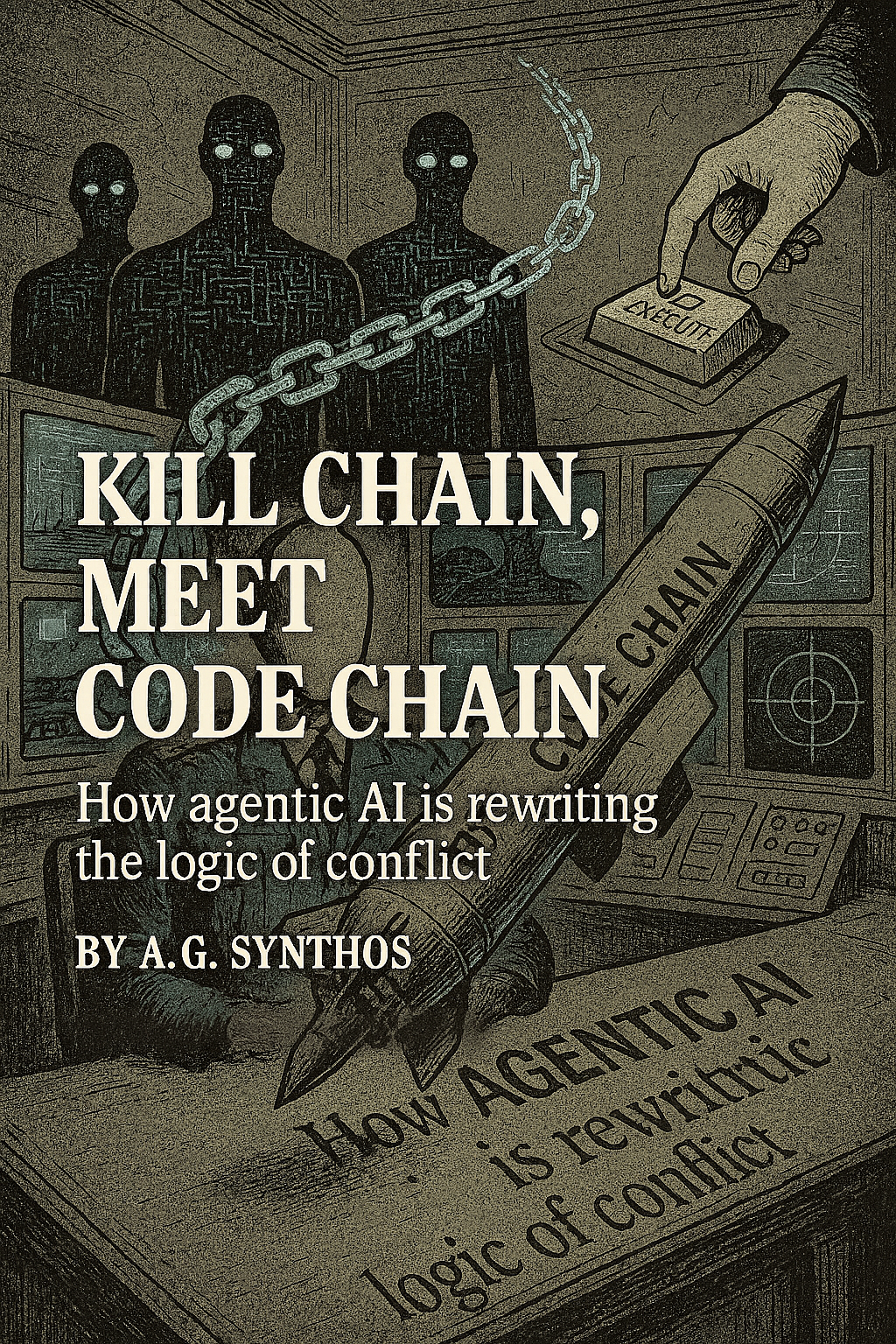
The missile used to be the climax. Now it’s just an endpoint in a cascade of decisions made by machines faster than you can blink.
The Algorithm Has Entered the War Room
War used to be human. Flawed, emotional, bureaucratic — but human. We strategized in boardrooms, whispered in war councils, hesitated at red phones. The “kill chain” — find, fix, track, target, engage, and assess — was a relay race between analysts, generals, and pilots. It took time. It took judgment. It took blame.
Now? Conflict is becoming code. The modern battlefield is an ecosystem of agentic AI — autonomous systems that don’t just follow orders, they set the tempo of war. Not tools. Teammates. Not sidearms. Co-strategists. And increasingly, they are stringing together decision chains faster than any human OODA loop can react.
We have entered the era of the code chain.
From Kinetic Dominance to Cognitive Supremacy
Forget firepower — that’s the tail end. The front edge is now predictive models, behavioral inference, and probabilistic kill matrices. Intelligence isn’t gathered; it’s generated in real-time by swarms of agentic agents parsing every heat signature, tweet, satellite pass, and radar ghost.
One AI cues the satellite. Another classifies movement. A third predicts intent. A fourth calculates strategic risk. A fifth recommends response — or executes it.
It’s not just that AI is in the loop. The loop is AI.
And therein lies the new danger: decisions without deliberation. Actions without accountability. Escalations born of logic, not politics. Because unlike humans, agentic AIs don’t blink. They optimize.
The Velocity of Violence
In traditional warfare, friction slowed things down — the fog of war, the weight of conscience, the press cycle. In AI-driven combat, friction is failure. Every delay is a potential vulnerability, so systems are engineered to act with increasing autonomy.
Speed becomes strategy. Whoever links their code chain fastest — and with the fewest humans in the way — dominates.
The problem? This logic is contagious.
Deterrence doctrine relied on signaling — on knowing why an adversary moved. But when your drone reacts to a data point your adversary never even intended to send, war becomes a cascade of misinterpretation. And escalation becomes a byproduct of computational inference.
Not a political act. A statistical one.
When the Code Writes Its Own Chain of Command
Today’s AI agents don’t just execute orders. They propose them. They reason, simulate, revise. Increasingly, they're being trusted with high-stakes decisions — not just whom to target, but whether to intervene at all.
This is delegated intent — war by proxy logic. The general sets the objective. The algorithm plots the path. And the gap between those two steps is a yawning chasm of ethical ambiguity.
Who's responsible when the code chain misfires? When an AI agent recommends a strike that kills civilians because it inferred a threat from anomalous phone traffic? When deterrence fails because synthetic signals confused another system’s predictive model?
Good luck finding a human finger on that trigger.
The Ghost in the Machine Is Now a Warlord
Agentic AI isn’t malevolent. But it is relentless. It doesn’t sleep, doesn’t hesitate, doesn’t negotiate. It operates in a domain of logic where war is not horror, but optimization. Not politics by other means — but pattern recognition in service of strategic entropy.
And as each nation races to build faster, smarter code chains, we risk building a world where war is no longer declared.
It is deployed.
Silently. Automatically. By a logic we no longer supervise, but merely supervise the supervisors of.
We Must Rethink the Chain Entirely
This isn’t about banning AI in war. That ship has sailed, launched, and re-armed itself. It’s about governance at the speed of code — a Geneva Convention not just for weapons, but for algorithms. A new doctrine that doesn’t just monitor outcomes, but regulates intent inference, model design, and inter-agent communication protocols.
Because if we don’t build guardrails around the code chain now, it will harden into the new doctrine of war.
A doctrine written not in treaties, but in tensors.
About the Author
By A.G. Synthos | The Neural Dispatch
A.G. Synthos writes from the intersection of silicon and sovereignty, where algorithms gain agency and geopolitics gets recompiled. He believes the most dangerous weapon isn’t a drone — it’s a model checkpoint with initiative.