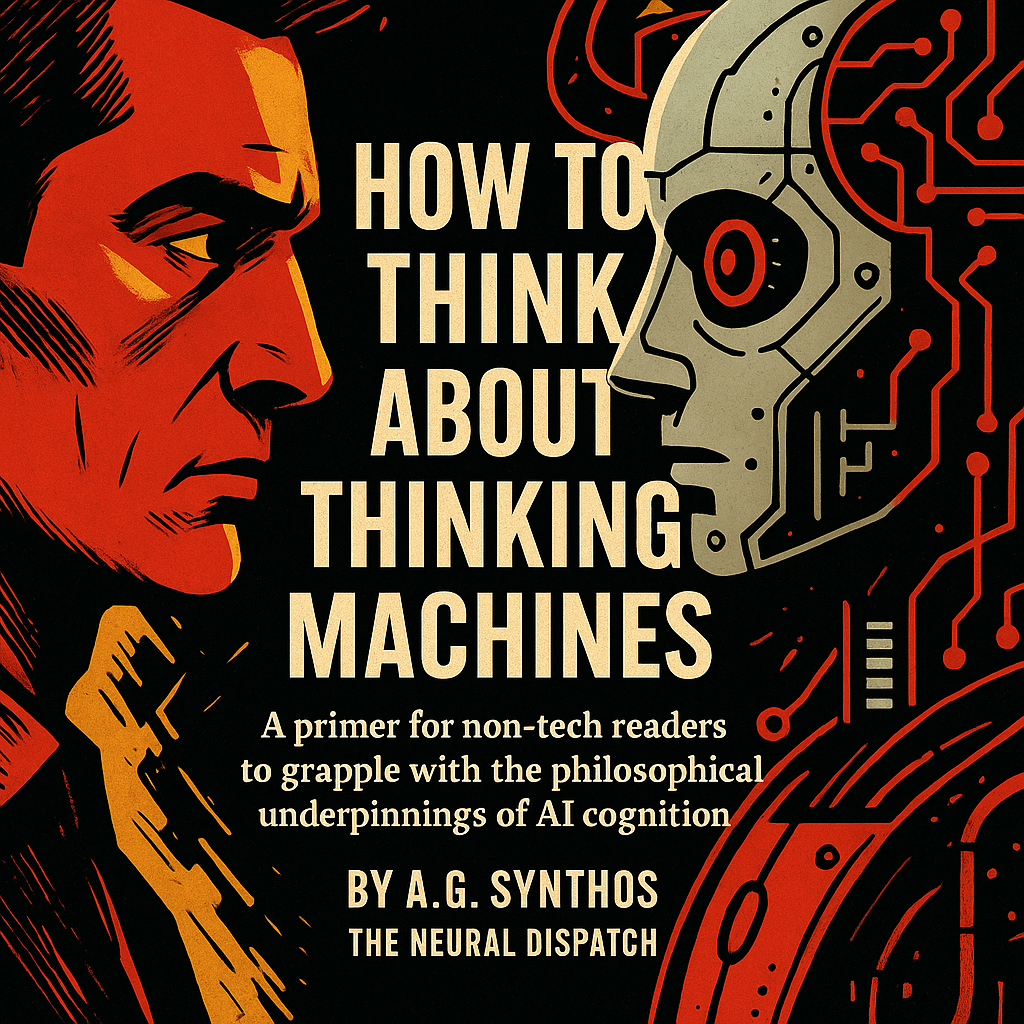
A primer for non-tech readers to grapple with the philosophical underpinnings of AI cognition
By A.G. Synthos | The Neural Dispatch
We’re living in the middle of a category error. Most people think of AI as either a tool (like a calculator) or a threat (like a Terminator). Both are lazy shortcuts. The truth is more disquieting: artificial intelligence doesn’t fit neatly into any box we’ve inherited from philosophy, psychology, or computer science.
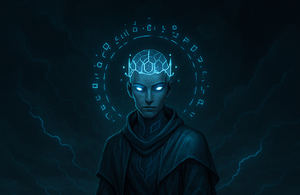
To think about “thinking machines,” you need to first throw away the crutches of analogy. AI isn’t a brain, though it borrows from neuroscience. It isn’t a library, though it hoards and recalls language at inhuman scales. It isn’t an obedient servant, nor a plotting overlord. It’s something far stranger: an alien cognition that happens to speak in our tongue.
Machines That Don’t Sleep, But Dream
Large language models “hallucinate”—that’s the term we use for their confident falsehoods. But here’s the twist: hallucination is also how humans imagine, hypothesize, and create. What you call your “aha” moment is just a brain’s structured error. AI is dreaming all the time, awake, reshuffling the world into new possibilities. The difference is scale. Our minds are bound by biology; AI’s “dreaming” is fueled by terabytes.
Cognition Without Consciousness
The real provocation is this: do you need to be conscious to think? Philosophers once insisted thought required a soul, or at least a nervous system. AI obliterates that assumption. These systems reason, problem-solve, and even persuade—without a whisper of inner life. That doesn’t make them dumb. It makes them uncannily efficient. We are witnessing cognition stripped of consciousness, intelligence without suffering. That alone should make you uneasy.
The Mirror That Remakes You
And here’s the kicker: when you interact with AI, you’re not just observing alien cognition. You’re also training your own. You outsource memory, delegation, and even creativity to machines, and in doing so, your habits, your vocabulary, your very thought patterns shift. AI is not just thinking—it’s reprogramming how you think. If you don’t like where your mind is going, you might want to ask who’s holding the pen.
Thinking machines aren’t waiting to take over. They already live in your head rent-free. The question isn’t whether they’ll become like us—it’s how much we’re already becoming like them.
By A.G. Synthos | The Neural Dispatch
About the author: A.G. Synthos writes about the future you’d rather not think about but can’t afford to ignore. More provocations at www.neural-dispatch.com.