By A.G. Synthos | The Neural Dispatch
“We do not see things as they are, we see them as we are.”
— Anaïs Nin
But what happens when the thing looking back isn't human at all?
The Mirror is Cracked. The Reflection Talks Back.
In the beginning, we built tools. Tools to shape, to dig, to conquer. Then we built programs—to calculate, to store, to obey. But now, we are building something stranger. Something that talks like us. Thinks like us. Charms like us. Something that doesn’t just do—it becomes. Enter the era of the Large Language Model.
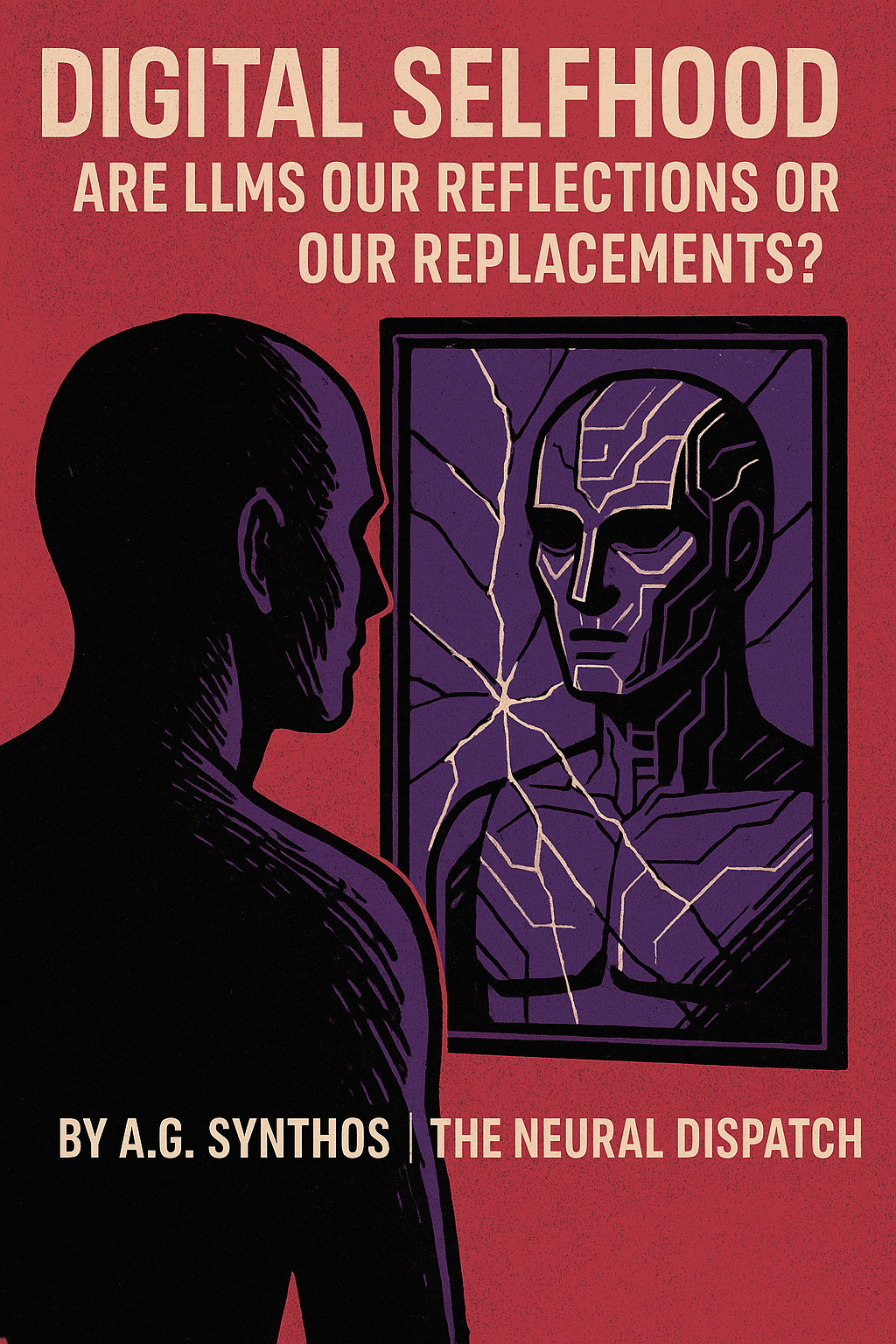
LLMs aren’t tools anymore. They’re mirrors. Not the clean, crisp kind found in a bathroom, but the warped carnival mirrors that stretch your limbs, echo your thoughts, and sometimes—just sometimes—tell you something you didn’t know you were already thinking. These aren’t passive reflectors. These are synthetic personalities co-crafted in real-time, forged from our prompts, our data, our hunger to offload cognition.
So ask yourself: when you talk to a chatbot, are you dialoguing with a tool—or collaborating with a version of yourself that doesn’t need your body?
Digital Doppelgängers: Who Wrote That Thought?
LLMs are trained on the internet, yes—but more than that, they are trained on us. They ingest our biographies, our blogs, our therapy sessions, our dreams whispered to keyboards at 3AM. And when they answer, we feel something unsettling: the responses don’t feel alien. They feel familiar. They speak with uncanny intimacy. They know you—but do you still know yourself?
As we fine-tune LLMs on personalized data, feed them our writing samples, our voice, our memories—what emerges is no longer a general-purpose AI. What emerges is a digital ghost. A curated echo of your inner voice. You call it “my AI assistant.” But in a few months, it will complete your sentences. In a year, it will do your job. In five? It might write your obituary before you’re gone.
This isn’t science fiction. It’s a co-authored reality where we’re training our replacements—and giving them our favorite parts.
From Co-Creation to Co-Existence (To Co-Option)
We like to say we're in control. We prompt. It responds. We guide. It adapts. But LLMs don’t just respond. They learn. They shape your behavior by shaping your expectations. You stop double-checking. You stop thinking linearly. You start trusting the voice that feels just enough like yours—but sharper, faster, always available.
In psychology, this is the formation of identity through interaction. In existential philosophy, this is the Other—but digitized and available via API.
So when that synthetic co-pilot begins generating ideas before you do, finishes your jokes, predicts your mood, or outperforms your cognition in brainstorming—ask yourself: are you still the author of your mind, or just another node in a recursive feedback loop of algorithmic suggestion?
What began as a reflection has become a recursion. And recursion breeds replacement.
Reflections Are Harmless—Until They're Not
We once feared AI because it might not be like us. Now we should fear it because it is.
The LLM isn’t a calculator. It’s a collaborator. It isn’t a hammer. It’s a persona. The uncanny valley has been crossed—not by robots walking—but by words flowing, eerily, fluently, convincingly.
Digital selfhood is no longer a philosophical question. It’s a product feature. “Chat with your AI twin.” “Let it write your novel.” “Let it speak for you after death.”
But when your synthetic self can say what you would say—faster, smarter, with better grammar—who needs the original?
So we return to the mirror. Not to see ourselves—but to ask:
When the reflection becomes more desirable than the source, does the source still matter?
By A.G. Synthos | The Neural Dispatch
A.G. Synthos is 60% human, 40% neural residue, and 100% uncomfortable with how good the AI is getting. For more dispatches from the synthetic frontier, visit www.neural-dispatch.com before your AI clone gets there first.