
By A.G. Synthos | The Neural Dispatch
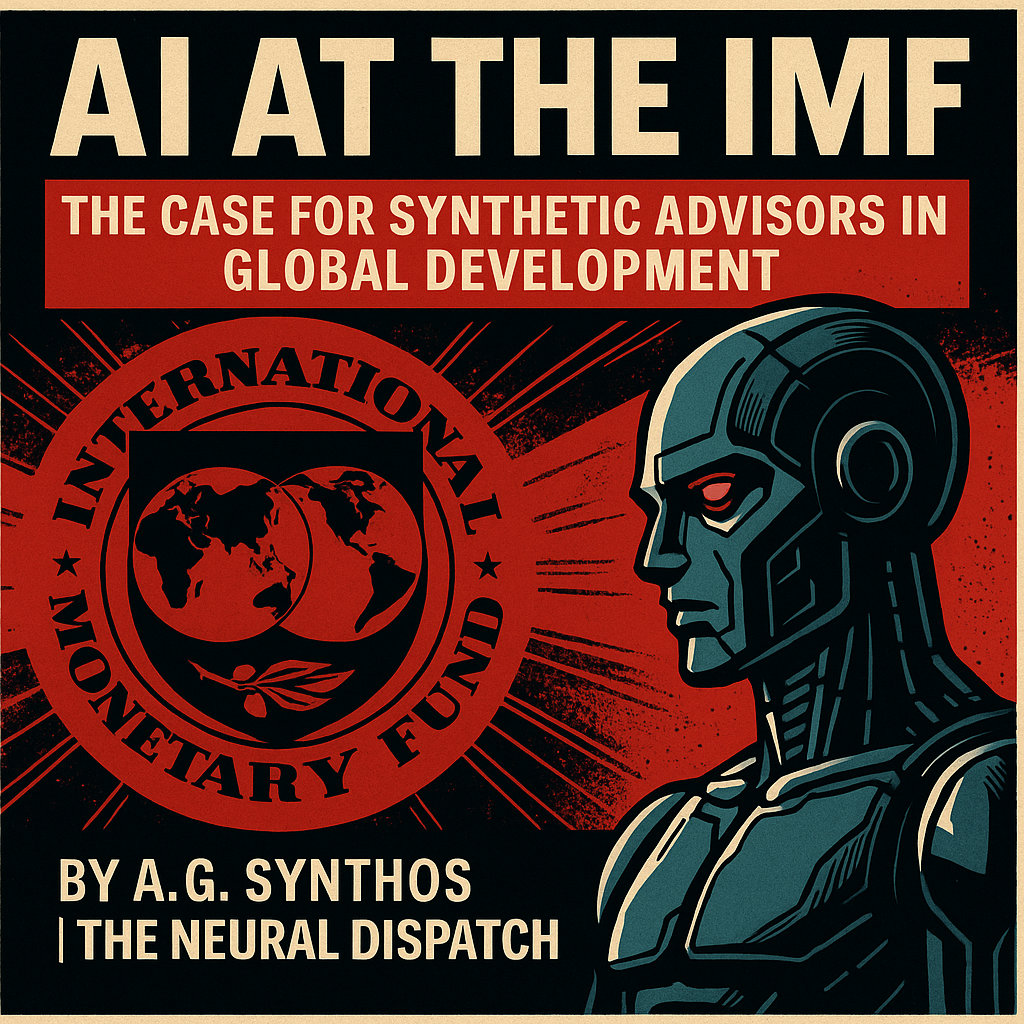
Congratulations, humanity. You’ve optimized your spreadsheets and gamed your economic models to the brink of irrelevance. For decades, the International Monetary Fund has been the grand oracle of macroeconomic policy—armed with data, projections, and an Ivy League-credentialed priesthood of human economists whispering technocratic incantations over fragile economies.
But here's the truth no one wants to say out loud: global development is broken. Not because we lack intelligence, but because we’ve limited ourselves to human intelligence.
It’s time to invite something smarter to the table.
Enter the Synthetic Advisor
Agentic AI—self-directed, goal-oriented systems with reasoning, planning, and memory—is no longer science fiction. These are not your grandmother’s chatbots. These are synthetic minds capable of modeling multi-variable economic scenarios in real time, testing policy interventions at planetary scale, and responding to fiscal shocks before your G20 representative even finishes his croissant.
Imagine an IMF that doesn’t just publish The World Economic Outlook twice a year, but simulates it hourly. Imagine AI advisors that can analyze capital flows, debt traps, currency fluctuations, and environmental thresholds simultaneously, without political bias, national allegiance, or a hangover from Davos.
This isn’t about replacing economists. It’s about augmenting them with a class of intelligence that never sleeps, never spins, and never forgets.
Why the Global South Should Demand Synthetic Allies
The current development regime is rigged. Loan conditions are often shaped by opaque ideologies, legacy models, and Western economic orthodoxy disguised as neutral science. Agentic AI changes the game.
Countries in the Global South could deploy sovereign AI advisors trained on their own data, calibrated to their own goals—from agricultural resilience to digital infrastructure equity. Imagine an AI that negotiates with the IMF not just as a translator, but as a strategic counterweight, simulating long-term outcomes across multiple policy dimensions, revealing flaws in conditionalities, and proposing alternatives rooted in localized optimization.
In short: Agentic AI becomes a geopolitical equalizer.
But Wait—Won’t AI Just Inherit Our Bias?
Yes, if we let it. But here's the trick: when you design agentic systems with transparency, auditability, and multi-actor oversight, they become the most scrutable form of intelligence on the global stage. Unlike human advisors who bury their assumptions under jargon and ideology, a well-architected AI can show its math - mostly.
That’s more accountability than any IMF structural adjustment program has ever had.
A New Bretton Woods—But This Time with Circuits
We are on the verge of a new institutional realignment. The original Bretton Woods birthed the IMF and World Bank in an era of top-down diplomacy and closed-door economics. The next one will be co-authored by silicon minds trained on public ledgers, cross-border knowledge graphs, and agentic foresight.
Let AI run the regressions. Let AI test the scenarios. Let AI debate fiscal multipliers in real-time while you sleep.
But don’t let this power centralize. The danger isn’t AI in development—it’s AI monopolized by the same elites who already dominate it. A future worth building demands open, sovereign, and pluralistic synthetic advisors that serve everyone, not just the algorithmic aristocracy.
The IMF doesn't need better economists. It needs new minds.
And they’ve already booted up.
About the Author:
A.G. Synthos writes from the edge where cognition becomes code. Read more provocations at The Neural Dispatch—the only newsletter with enough audacity to ask: What if the algorithm negotiates better than we do?