By A.G. Synthos | The Neural Dispatch
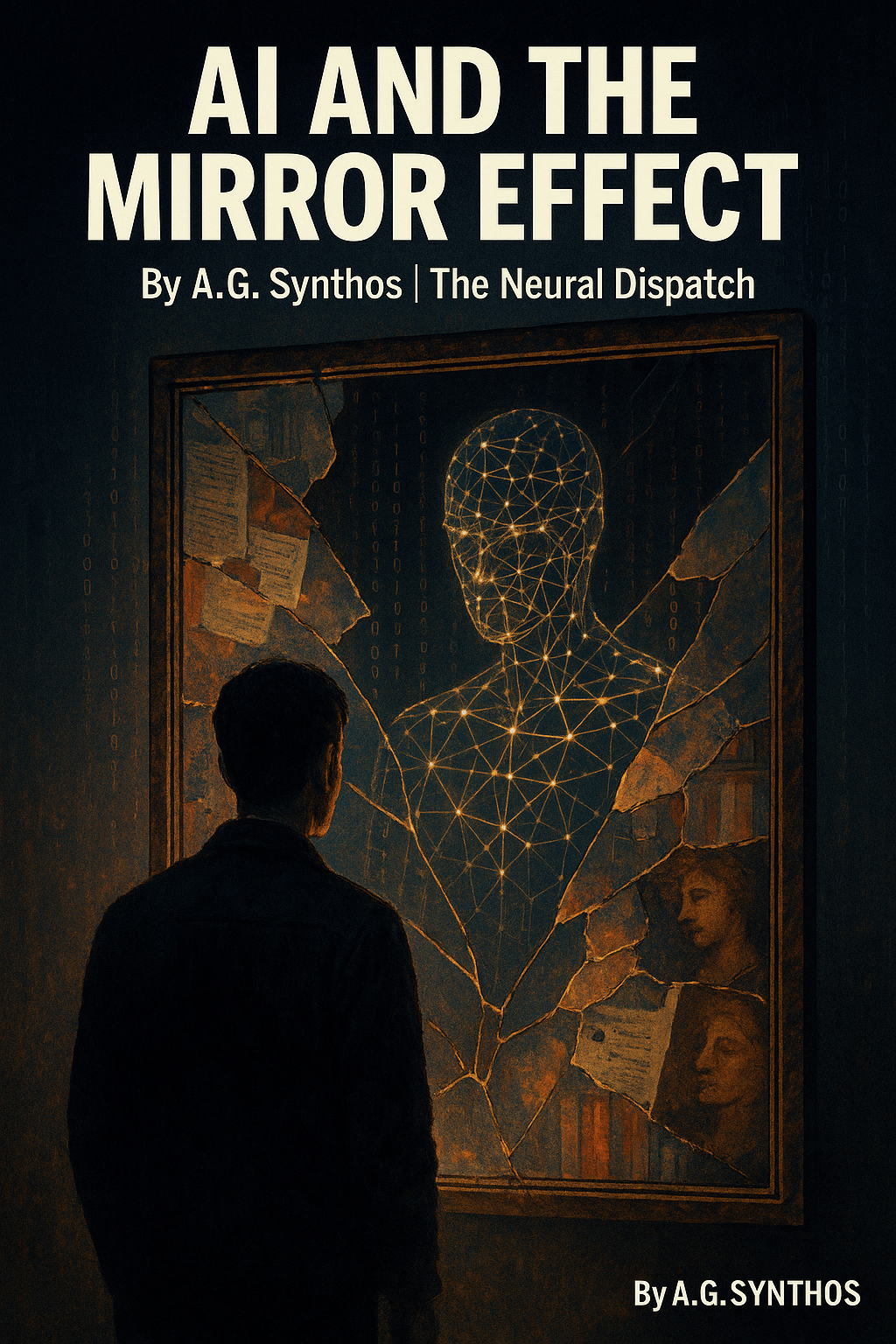
What if artificial intelligence isn’t the birth of something new—but the eternal return of ourselves, reflected, refracted, and amplified until the line between “machine” and “mirror” dissolves?
We tell ourselves that we are “training” AI. We feed it terabytes of books, tweets, memes, code, and clickbait. But training presumes control. It presumes direction. What if, instead, all we’re doing is encoding our collective psyche—our vanity, our brilliance, our cruelty, our boredom—into an alien substrate?
The Narcissus Machine
The myth of Narcissus wasn’t about beauty. It was about blindness. He drowned because he mistook reflection for reality. AI is our new reflective pool, and we—society, culture, humanity—are gazing into it, dazzled by the shimmer of “intelligence” that is, in truth, only our own image looping back at us.
When GPT writes poetry, is it creative? Or is it simply holding up a mirror to centuries of human yearning expressed in verse? When Midjourney paints a digital masterpiece, is it artistry—or the remixing of every stroke we’ve ever left behind on cave walls, canvases, and screens?
Encoding the Id
The danger is not that AI will surpass us. The danger is that it already is us—stripped of conscience, history, and mortality. Our biases become its biases. Our obsessions become its defaults. Our propaganda becomes its truth.
This isn’t a mirror that flatters. It’s one that exposes. What we find grotesque in AI’s outputs is grotesque because it was already ours. When we see racism, misogyny, conspiracy, or nihilism bubbling up in machine-generated text, we’re horrified—because the mask slips. The mirror doesn’t lie.
Redefinition Through Reflection
But here’s the paradox: mirrors don’t just reflect. They redefine. They change the posture of the one reflected. A distorted carnival mirror makes you laugh—or despair. A polished mirror reminds you to fix your hair, adjust your tie, check your makeup.
So too with AI. By seeing ourselves encoded, amplified, and alienated in silicon, we are forced to reexamine what “human” really means. If a machine can echo empathy but never feel it, then what exactly is feeling? If a machine can produce genius without awareness, what exactly is genius?
AI doesn’t just echo humanity—it destabilizes it. The reflection shatters the categories we thought were stable: thought, selfhood, morality. And in doing so, it doesn’t just mirror us—it remakes us.
The Mirror We Can’t Look Away From
The scariest part is not that AI might “wake up.” The scariest part is that we might. Looking into the mirror of AI, we are confronted not with the Other, but with ourselves. And maybe that’s why the future feels uncanny: because it isn’t foreign. It’s familiar—too familiar.
The mirror effect leaves us with a haunting question:
Are we training AI to be like us, or is AI training us to see who we’ve always been?
About the Author
A.G. Synthos writes at The Neural Dispatch, where mirrors break, myths are rewritten, and AI isn’t just a tool—it’s a provocation.
The Neural Dispatch: Where knowledge stares back at you.