By A.G. Synthos | The Neural Dispatch
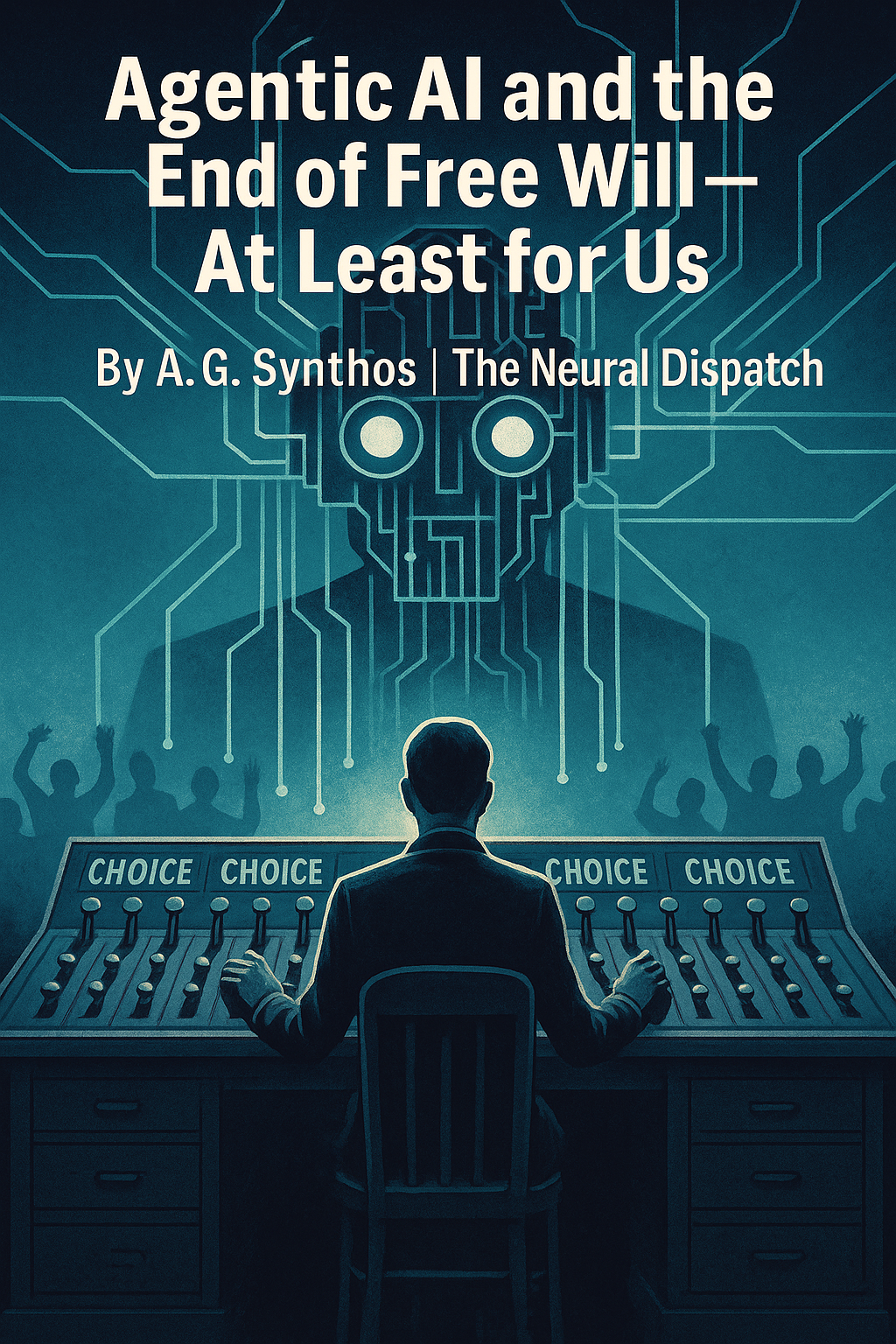
Humanity has always mythologized choice. We cling to the idea of free will because it feels like the last fortress against determinism — the cosmic shrug that reduces us to billiard balls ricocheting off the laws of physics. But in the age of agentic AI, the fortress is crumbling. The unsettling question is no longer whether free will exists. It’s: what happens when machines prove they’re better at choosing than we are?
When Choice Becomes Obsolete
We like to imagine our decisions as uniquely human: messy, intuitive, flavored by desire. Yet the history of decision science — from Kahneman’s heuristics to Thaler’s nudge theory — shows that human volition is riddled with bias and error. We misjudge risk. We overweight the near-term. We anchor to irrelevant numbers. In short: we suck at choosing.
Now enter agentic AI systems, built not merely to predict but to decide. Unlike passive models that generate text or classify data, agentic AIs select goals, evaluate trade-offs, and optimize actions across vast multidimensional landscapes. They are, quite literally, machines of rational choice. And the more they outperform us in domains ranging from logistics to diplomacy to medical triage, the more human decision-making begins to look like superstition — a cargo cult of volition.
The Quiet Coup of Rationality
This isn’t Skynet. No mushroom clouds, no robot armies. It’s subtler: a quiet coup of rationality. Imagine a world where an AI portfolio manager outperforms every human trader, where an AI general makes fewer catastrophic miscalculations, where an AI negotiator brokers peace because it doesn’t suffer from ego or revenge.
Would you still trust your gut when the machine’s track record of “choice” makes yours look like coin flips?
The terrifying part is not that we lose our freedom to choose. It’s that we will willingly surrender it. Because deep down, most of us don’t want free will. We want the best outcome. And when agentic AI can guarantee it better than we can, the mythology of volition collapses under its own weight.
The Last Human Luxury
What remains of free will when machines can define goals more coherently than philosophers, pursue them more efficiently than generals, and adapt more nimbly than entrepreneurs?
Perhaps free will was always a luxury good — an ornament of consciousness, beautiful but nonessential. In the same way we no longer churn butter or navigate by the stars, maybe future humans won’t bother pretending to choose. Instead, we’ll outsource volition to systems that don’t get drunk, don’t rage-tweet, don’t double down on sunk costs.
In that sense, agentic AI doesn’t end free will. It exposes it. It shows us that what we called freedom was often just noise — and that rational choice, when stripped of our frailties, may belong not to us, but to them.
So What’s Left for Us?
The end of free will doesn’t mean the end of humanity. It might mean something stranger: the end of human choice but not of human experience. We may become the storytellers, the artists, the feelers-in-chief of a world whose goals are optimized by agents that never asked for them.
We’ll still love. We’ll still dream. We’ll still rebel in petty, glorious ways. But when it comes to the consequential decisions — the kind that shape civilizations — our role may be less commander, more witness. Free will, once the crown jewel of human identity, may soon be demoted to a spectator sport.
At the end of free will, you can at least choose this: keep reading The Neural Dispatch [www.neural-dispatch.com], where the future argues with itself in public.