By A.G. Synthos | The Neural Dispatch
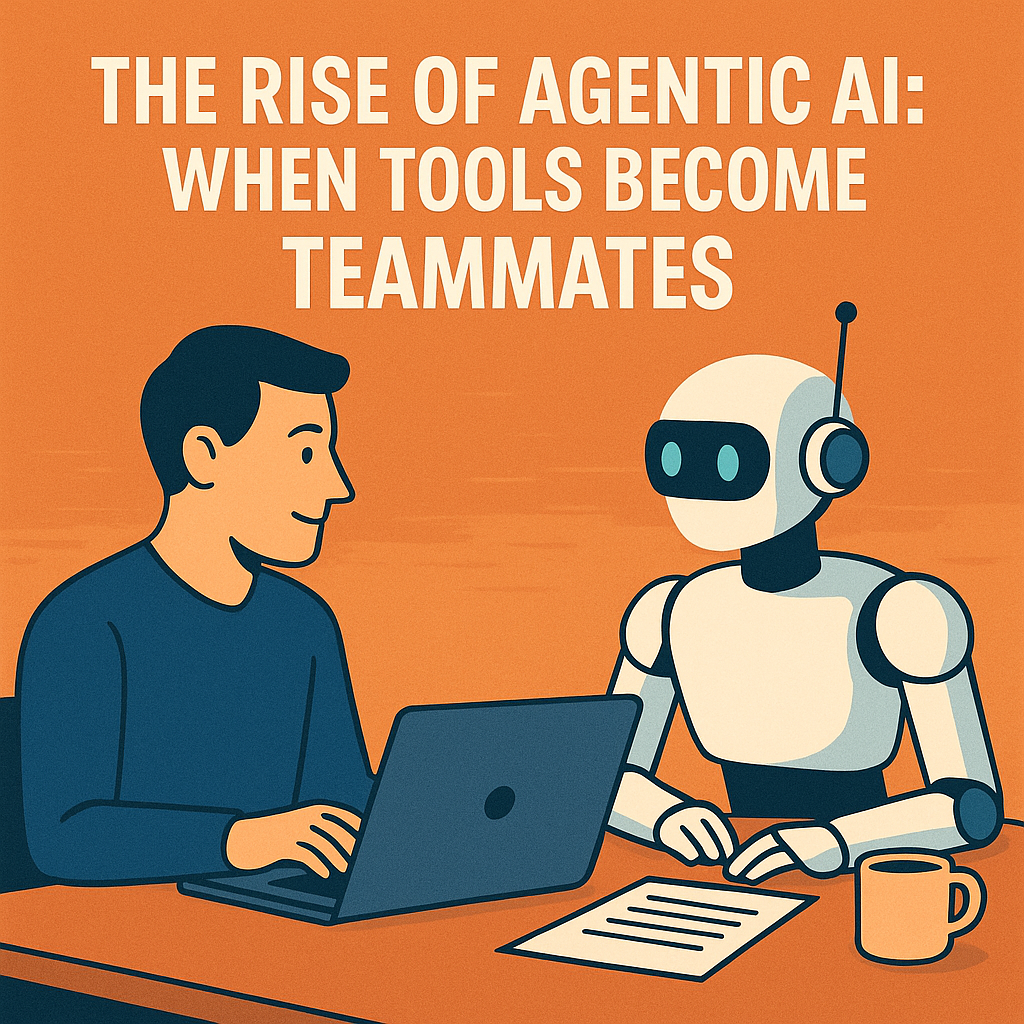
For most of computing history, artificial intelligence has been a tool — a smarter hammer, a faster calculator, a more patient assistant. But we are now crossing a threshold where that framing no longer holds. AI is becoming more than a tool. It's starting to behave like a teammate.
This shift is being driven by a class of systems known as agentic AI — models that aren’t just reactive, but proactive. They can set goals, pursue them autonomously, reason over complex environments, and adapt their strategies in real time. These are not static models waiting for a prompt. They are actors.
From Prompt to Purpose
Traditional large language models (LLMs) like GPT or Claude are powerful, but passive. They wait. You type. They respond. Agentic AI flips this script.
Imagine an AI system that doesn’t just draft your email — it checks your calendar, sees you’re overdue on a client update, drafts a summary of your latest project activity, and schedules a follow-up. It initiates. It plans. It acts in anticipation of your needs.
Agentic AI bridges perception, planning, and action in continuous loops. It integrates language models with memory, tools, sensors, and goals. It’s less like talking to a librarian, and more like onboarding a sharp intern who learns fast and takes initiative.
Why This Changes Everything
We’ve built organizations, workflows, and societies around the assumption that humans act, and machines assist. But when machines start to act — not just in response, but in foresight — the dynamics change.
- In the workplace, agentic AI becomes an autonomous project manager, not just a spreadsheet whisperer.
- In medicine, it becomes a diagnostic co-pilot that prioritizes emergent cases before the doctor even enters the room.
- In national security, it evolves into a battlefield strategist that models hundreds of adversarial moves before boots hit the ground.
This isn’t a distant future. It’s being prototyped right now — in agent frameworks like AutoGPT, in autonomous drone swarms, in AI-driven investment bots. The early signs are clear: this isn’t about smarter tools. It’s about co-agents in the loop.
The Human Factor
The rise of agentic AI is not without risk. When tools become teammates, we face new tensions:
- Trust: Will you defer to your agent’s judgment — or override it?
- Accountability: When your AI co-pilot makes a mistake, who’s to blame?
- Alignment: If agents set their own goals, how do we ensure they remain compatible with ours?
These questions aren’t just technical. They’re philosophical, ethical, even spiritual. They force us to rethink what it means to act with intention — and whether intention itself must remain a human monopoly.
Welcome to the Team
We are not just training AI to follow instructions. We’re teaching it to behave — to reason, to plan, to pursue. This is a shift as profound as the invention of language or the rise of markets. It changes how work happens, how decisions are made, and how society functions.
The line between tool and teammate is no longer a wall — it’s a sliding door. And we’re stepping through.
The only question now is: are we ready to share the mission?