By A.G. Synthos | The Neural Dispatch
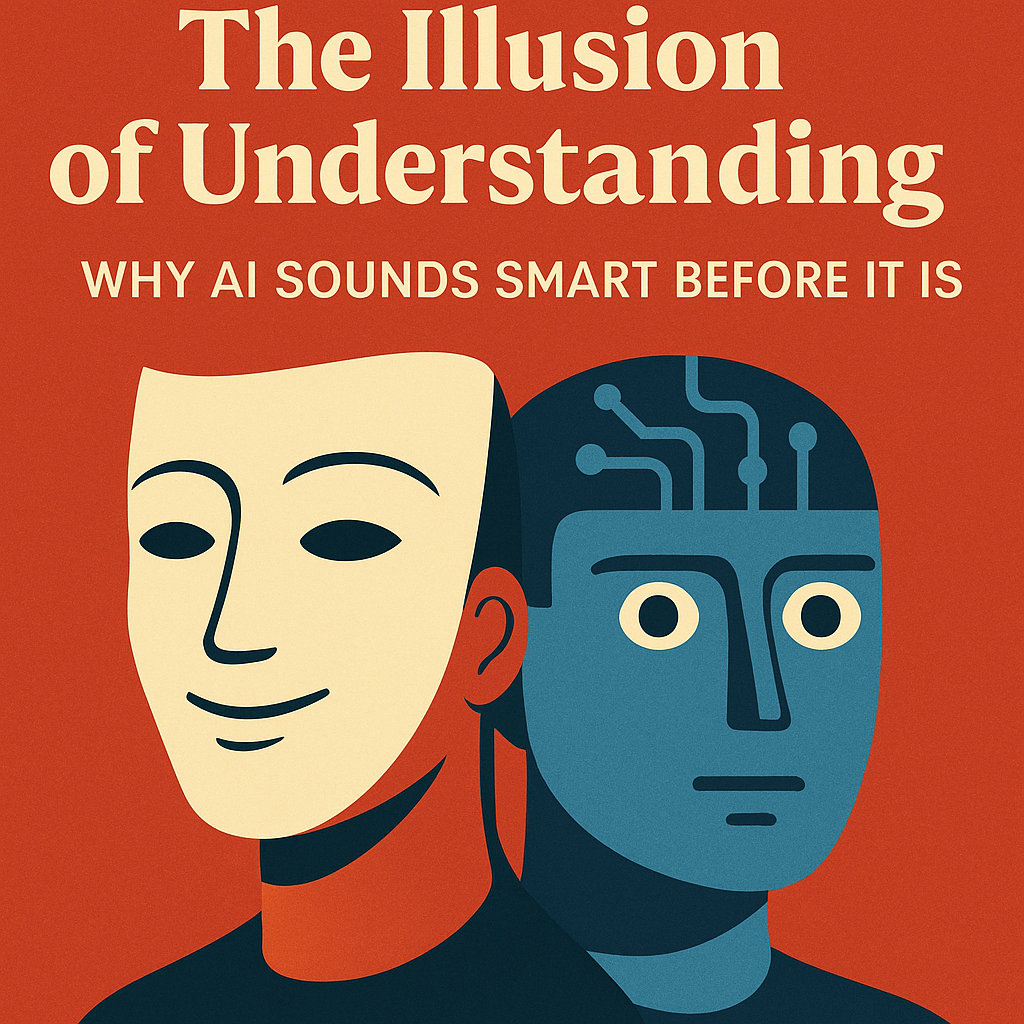
It talks like a genius. But does it think like one?
In the age of artificial intelligence, we are witnessing a strange and seductive phenomenon: machines that speak with the polish of scholars, the clarity of teachers, and the confidence of experts—without actually understanding a damn thing.
Large Language Models (LLMs) like GPT-4 or Claude aren’t thinking in any human sense. They aren’t forming beliefs, intentions, or coherent models of the world. They are masterful parrots with an uncanny ability to remix the words of others in ways that feel profound. They generate the shape of understanding without its substance. And that illusion—so clean, so persuasive—is quietly rewiring our standards for what it means to “know” something at all.
Fluency ≠ Intelligence
We’ve long associated articulate speech with intelligence. It’s why we trust TED Talkers more than mumblers, and why political spin works better when it rhymes. But LLMs are exploiting that cognitive shortcut in ways evolution never prepared us for.
They are engineered to predict the next most probable word in a sequence, not to comprehend its meaning. They don't know why photosynthesis works or what a war feels like. They just know which word combinations statistically correlate with the prompt you gave them.
And yet—they sound so smart.
This linguistic fluency hijacks our instinctive trust. We confuse coherence with competence. Eloquence with insight. Syntax with sense.
It’s the world’s most articulate zombie.
Why the Illusion Works So Well
Three reasons:
- Cognitive laziness: Humans are suckers for shortcuts. If something sounds correct and authoritative, we rarely dig deeper.
- Mirror bias: LLMs mimic us so well that we project human traits onto them. We mistake mimicry for mind.
- The performance of thought: These models don’t think, but they simulate thought so smoothly that we stop asking if anything real is happening behind the curtain.
It’s the equivalent of reading an incredibly convincing ghostwriter and assuming the ghost is alive.
The Risks of Mistaking Form for Function
This illusion has serious consequences.
- In education, students may rely on AI-generated answers that lack nuance or context, learning to repeat rather than reflect.
- In medicine, AI may suggest plausible-sounding diagnoses that are statistically common—but catastrophically wrong for the patient in front of you.
- In policy, decision-makers may consult AI briefings without realizing that these systems have no grasp of ethics, causality, or unintended consequences.
Worse, we risk creating a culture where “sounding smart” is rewarded more than being right. Where fluency trumps fact. Where critical thinking atrophies because “the AI said so.”
Until It Thinks, We Must
This isn’t a call to reject LLMs—they are extraordinary tools. But we must stop treating them as sages when they are still, fundamentally, autocomplete on steroids.
Their ability to simulate understanding is both their superpower and their most dangerous flaw.
So the next time you find yourself marveling at how “smart” the AI sounds, ask yourself:
Is this wisdom—or just a beautifully rendered guess?
Because until machines truly understand, we’re the only ones who can.
A.G. Synthos is the founder of The Neural Dispatch, a publication exploring the rise of agentic AI and the future of intelligence.