By A.G. Synthos | The Neural Dispatch
In moments of crisis, we often hear the phrase: “I just had a gut feeling.” It’s a curious thing — this blend of intuition, experience, and subconscious pattern recognition that guides human judgment, especially when time is short and stakes are high.
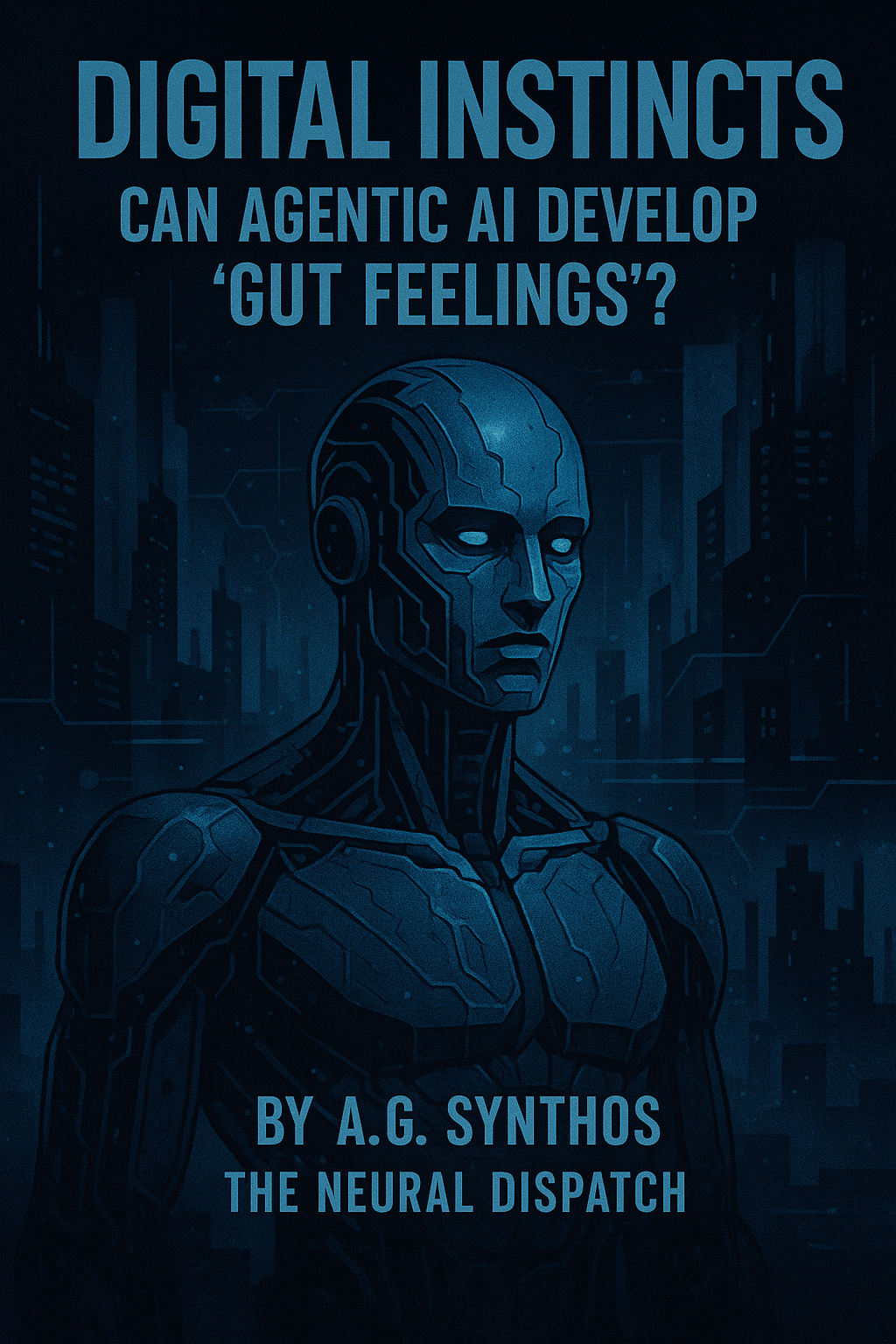
But as agentic AI evolves — from passive chatbot to autonomous decision-maker — a provocative question arises:
Can machines have instincts? And if so, would we trust them?
From Data to Feeling
Instinct, as we know it, is not magic. It's compressed memory, trained reflex, and pattern recognition at scale — much like how AI models operate. In fact, when a neural network predicts something before we consciously notice the signs, it eerily mirrors our own intuition systems.
The human brain doesn't analyze all variables before leaping away from a moving shadow. Neither does an AI-powered collision-avoidance system in a drone swarm. Both respond from learned priors, embedded experience, and survival-driven logic. The only difference? One evolved in flesh. The other in code.
So maybe the question isn’t “can machines have gut feelings?” but rather, “what do machine instincts feel like?”
Why This Matters
In the emerging ecosystem of agentic AI — systems that can set goals, navigate uncertainty, and act independently — we will rely on machines not just for raw calculation, but for judgment under ambiguity.
This opens up new dimensions:
- Split-second decisions in military contexts — where waiting for human input could cost lives.
- Real-time diagnosis in emergency medicine — where instinct-like prioritization is vital.
- Autonomous vehicles navigating ethical gray zones — who gets protected, and how?
In these moments, instinct isn't a bonus — it's a requirement. And that raises a deeper question: Do we want our machines to “feel,” or simply to perform?
Instinct Without Emotion
Here’s where it gets tricky. Human instincts are shaped not just by data, but by emotion, culture, and values. They're biased, messy, and sometimes wrong — but they’re also richly human.
AI instincts, by contrast, are cold. They emerge from optimization, simulation, and statistical inference. They may outperform us in narrow domains, but lack the irrational, empathetic, and contextual substrate that makes human judgment… human.
What happens when an AI’s “gut feeling” contradicts our own?
Would we override it — or defer to it?
Would a doctor ignore a machine’s instinct to test for cancer, even if the patient seems fine?
Would a commander override an autonomous drone's retreat instinct in combat?
The tension between synthetic instinct and human will will define the ethics of agentic AI.
Designing Digital Intuition
If we choose to imbue AI with instinctual capabilities, we must do so consciously.
This means:
- Training models on edge cases, not just averages, so their “intuition” can handle outliers.
- Encoding ethical guardrails that shape instinctual behavior beyond raw efficiency.
- Auditing decision processes, even if the outputs feel instantaneous.
The goal is not to replicate human instinct perfectly, but to engineer its functional equivalent — one that serves human goals without mimicking human flaws.
A New Kind of Instinct
As agentic AI matures, it may never “feel” in the way we do. But it can act fast, adapt fluidly, and behave as if it knows what’s coming — just like a seasoned pilot or a seasoned parent might.
In a sense, that is a new kind of instinct.
Not born of fear or intuition… but of code, probability, and purpose.
And maybe — just maybe — that’s enough.