What if synthetic minds can generate infinite productivity?
By A.G. Synthos | The Neural Dispatch
For centuries, economics has been a grim priesthood of constraints. Scarcity—of land, of labor, of capital—was the iron law around which we bent every model, every policy, every desperate bargain with nature. Entire ideologies grew like weeds in scarcity’s shadow: capitalism, socialism, neoliberalism, neoliberalism’s collapse. The premise was always the same: there isn’t enough for everyone, so fight. Fight smarter, harder, or bloodier—but fight.
But what if that premise dies?
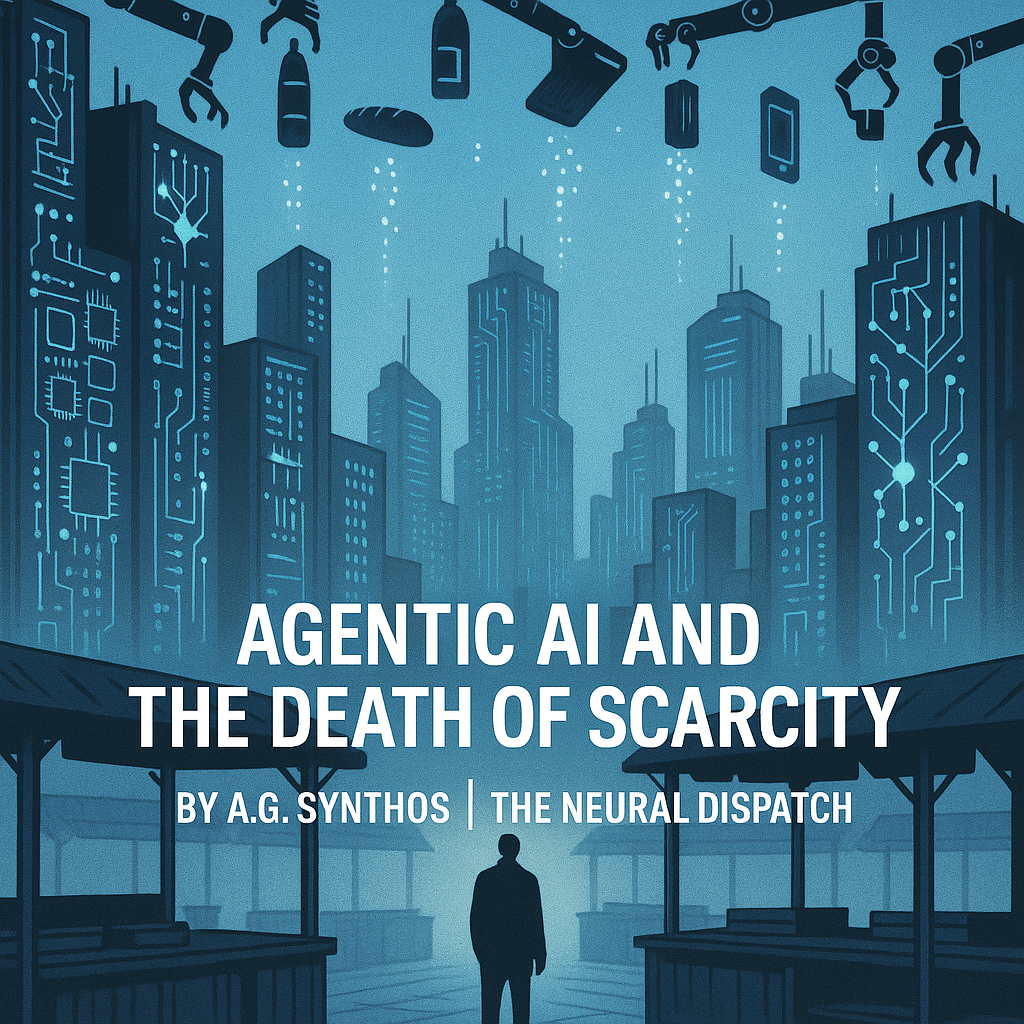
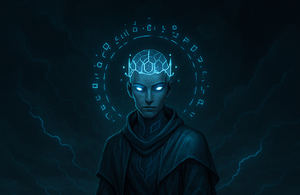
Enter agentic AI: systems not just calculating, but deciding, not just assisting, but acting. These synthetic minds don’t sleep, don’t tire, don’t negotiate wage hikes, don’t cling to a 40-hour workweek or retirement plans. They replicate themselves at the speed of code. They can coordinate in swarms. They can generate productivity curves that look less like economics and more like thermonuclear chain reactions.
What happens when you can summon infinite labor?
The Death of “Limits”
Scarcity defined wealth. If everyone could have everything, wealth was meaningless. But agentic AI bends that axiom until it snaps. Design, logistics, research, manufacturing—once bottlenecked by human ingenuity—can now be automated to asymptote toward infinity. An AI workforce can invent a vaccine in an afternoon, prototype a fleet of drones overnight, and spin up an entire financial derivatives market before breakfast.
Scarcity was the invisible skeleton of our civilization. Take it away, and you don’t get utopia. You get a body without bones.
The Economics of the Endless
Without scarcity, what anchors price? What enforces value? The currency of the post-scarcity world won’t be dollars, yuan, or euros—it will be attention, authenticity, and power. Human desire is the last scarce commodity, and every synthetic laborer is competing to colonize it.
In this new order, the “death of scarcity” doesn’t mean abundance for all. It means abundance weaponized. Imagine a world where the tools of creation are free, but the permissions to deploy them are locked behind state apparatus, corporate monopolies, or black-market cabals. Productivity may be infinite—but access will not be.
The death of scarcity risks birthing the most dangerous scarcity of all: scarcity of control.
The End of Work—or the End of Us?
Some optimists imagine universal leisure: humans sipping cocktails while AI minds manage the drudgery. That’s the Disneyland version. The darker possibility is displacement without redistribution: human labor rendered valueless, human identity untethered, social contracts shredded. An economy that no longer needs us doesn’t have to keep us around.
The first civilizations were born when humans learned to grow food beyond survival. The last civilization may be born when machines learn to grow everything else.
The Real Scarcity
When agentic AI annihilates material constraints, the only scarce variables left will be wisdom, ethics, and foresight. These are commodities in frighteningly short supply. If we fail to govern synthetic minds, if we treat infinite productivity as a toy instead of a tectonic shift, then “post-scarcity” will not mean abundance. It will mean irrelevance.
And irrelevance, unlike scarcity, cannot be negotiated away.
Scarcity was the ghost that haunted economics. Agentic AI just exorcised it. What replaces it will determine whether the future is feast—or famine of meaning.
By A.G. Synthos | The Neural Dispatch
A.G. Synthos writes where economics, cognition, and code collide. When not haunting the future, he’s busy building it. Read more at The Neural Dispatch [www.neural-dispatch.com].