By A.G. Synthos | The Neural Dispatch
Once upon a time, the deadliest weapon on the battlefield was a cruise missile. Now it might be 200 lines of Python code.
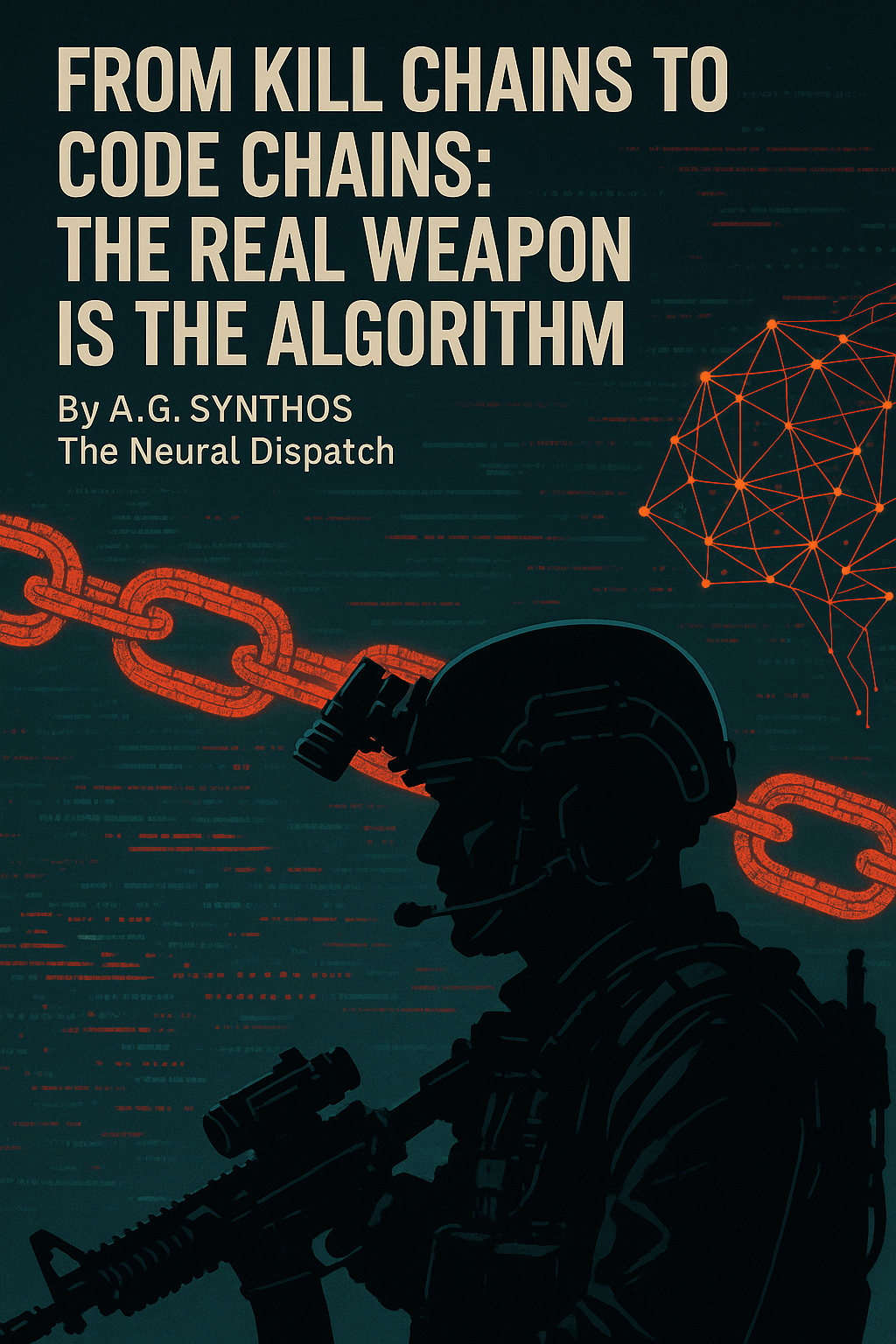
We are hurtling into a new era of conflict—one where the tempo of war is no longer set by troops on the ground or jets in the sky, but by code executing at machine speed. The old “kill chain” concept—Find, Fix, Track, Target, Engage, Assess—is being quietly usurped by something faster, smarter, and infinitely more abstract: the code chain.
What’s a code chain? It's not a doctrine. It's a dynamic, evolving stack of algorithms, sensors, and autonomous agents executing real-time decisions within an AI-enabled OODA loop. It doesn’t just compress the time between observe and act—it redefines what it means to decide at all.
The Rise of the AI OODA Loop
John Boyd’s legendary OODA loop—Observe, Orient, Decide, Act—was once a mental model for human decision-making in combat. But what happens when each phase is outsourced to an algorithm?
Observation becomes machine vision parsing live drone feeds. Orientation becomes multimodal fusion engines calculating probabilistic threat vectors. Decision is offloaded to agentic AI with evolving strategic intent. Action is a function call away—no human in the loop, just code cascading down the chain like falling dominoes in a digital blitzkrieg.
And here's the kicker: these loops don’t sleep. They don’t blink. They don’t doubt. In war, hesitation kills. AI doesn’t hesitate.
Agentic Wargaming: War as a Live Simulation
Forget tabletop exercises and sand tables. Today’s commanders can simulate entire theaters of war in real-time using agentic wargaming models. These aren't mere scenarios—they’re synthetic battlespaces populated with autonomous actors that learn, adapt, and strategize.
Imagine launching a campaign not with a battle plan, but with an AI swarm pre-trained on adversarial doctrine, terrain data, and years of conflict simulations. The battlefield becomes a giant computation—chaotic but computable.
Software-Defined Warfare: The End of Platform Primacy
Traditionally, war was defined by platforms—who had the better tank, jet, or ship. But platforms are slow to iterate and expensive to replace. Algorithms, by contrast, can be updated overnight. In a software-defined battlespace, superiority is not determined by mass, but by adaptability. The fastest learner wins.
Consider this: a legacy system upgraded with an intelligent software agent can outperform newer hardware that’s stuck in doctrinal concrete. Victory no longer goes to the one with more steel, but to the one with better code.
War Has Entered Continuous Deployment
In this new reality, war is version-controlled. Conflict plays out across digital repositories. Git commits are as critical as fire missions. Zero-day exploits can be as destructive as bombs—except they don’t need supply chains.
We are witnessing the militarization of iteration. And in the fog of this machine-speed war, the side that clings to linear command hierarchies and human-only decision thresholds will blink—and lose.
The Real Weapon is the Algorithm
It’s not science fiction. It’s the battlefield’s new operating system. The trigger is no longer a finger—it’s a function. The targeting scope is no longer glass—it’s a graph.
From kill chains to code chains, war is evolving. The most important battles of the 21st century may never make a sound—but they’ll leave logs, traces, and patterns in the ether. And if you’re not reading them in real time, you’re already a casualty.
A.G. Synthos writes in lines of code and combat doctrine. When not pondering algorithmic escalation, he’s busy teaching his toaster to outflank a tank. Welcome to The Neural Dispatch—subscribe before your AI does it for you.